SAUDI ARABIA
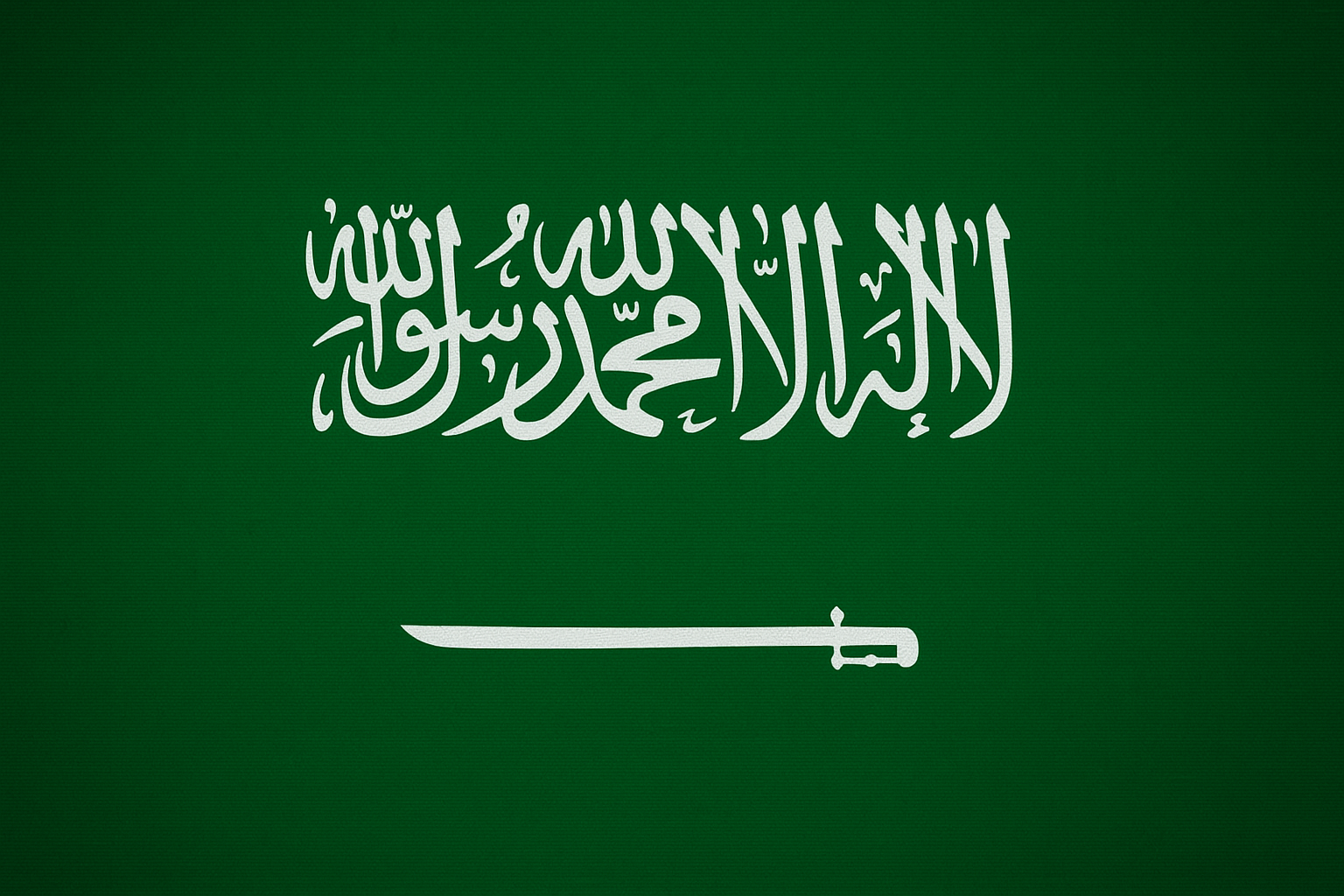
Flag of Saudi Arabia
The flag of Saudi Arabia is green in color and features white Arabic inscription and a sword. The Arabic text is the Shahada, the Islamic declaration of faith, which states belief in one God and Muhammad as His messenger. Below the inscription lies a horizontal white sword, symbolizing justice and strength. The green color represents Islam. Due to its religious significance, the flag is never flown at half-mast or used for decorative purposes.
Introduction
Saudi Arabia, officially known as the Kingdom of Saudi Arabia, is a prominent country in the Middle East and holds immense religious, political, and economic importance. Established in 1932 by King Abdulaziz Al Saud, the nation is known as the birthplace of Islam and home to its two holiest cities, Makkah and Madinah. With a rich history rooted in tradition and a rapidly transforming modern identity, Saudi Arabia plays a crucial role on the global stage.
Geography and Climate
Saudi Arabia occupies most of the Arabian Peninsula, making it one of the largest countries in the region. It is bordered by the Red Sea to the west and the Arabian Gulf to the east. The country’s landscape is dominated by vast deserts such as the Rub’ al Khali (Empty Quarter), mountains in the southwest, and long coastlines. The climate is generally hot and dry, with extreme summer temperatures and limited rainfall.
Religion and Cultural Significance
Saudi Arabia holds unparalleled religious importance for Muslims worldwide. Makkah is the birthplace of Prophet Muhammad and the site of the Kaaba, toward which Muslims pray. Madinah houses the Prophet’s Mosque and his tomb. Every year, millions of pilgrims visit the country to perform Hajj and Umrah, making Saudi Arabia the spiritual center of the Islamic world. Saudi culture is deeply influenced by Islamic traditions, Arabic language, and tribal heritage.
Political System and Governance
Saudi Arabia is a monarchy, governed by the Al Saud royal family. The King serves as both head of state and government. The country follows Islamic law (Sharia) as the basis of its legal system. In recent years, the leadership has focused on administrative reforms, modernization, and increased participation of citizens in various sectors, while maintaining strong traditional values.
Economy and Natural Resources
The Saudi economy is one of the strongest in the Middle East, largely due to its vast oil and natural gas reserves. As one of the world’s leading oil producers and exporters, Saudi Arabia plays a key role in global energy markets. Alongside energy, the government is investing in infrastructure, tourism, technology, and renewable energy to diversify the economy and reduce dependence on oil.
Vision 2030 and Modern Transformation
Under Vision 2030, Saudi Arabia is undergoing major social and economic changes. The initiative aims to promote economic diversification, expand tourism, empower youth and women, and develop sectors such as entertainment, sports, and innovation. Cities like Riyadh, Jeddah, and NEOM reflect the country’s ambition to become a global hub for business and culture.
Conclusion
Saudi Arabia is a nation where deep-rooted traditions coexist with ambitious modernization. Its religious significance, economic strength, and strategic vision make it a key player in regional and global affairs. As the country continues to evolve, Saudi Arabia remains firmly connected to its cultural and Islamic identity while shaping a dynamic future.