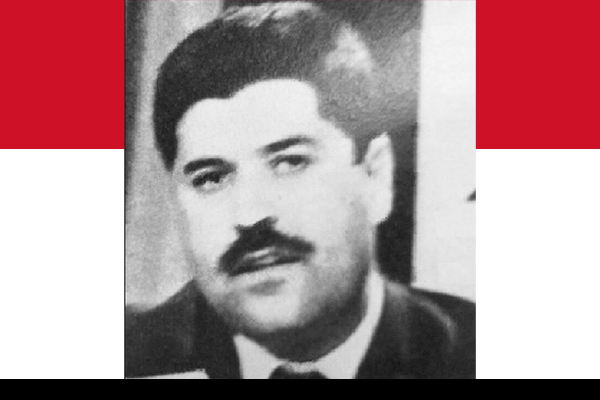
Yusuf Zuayyin (Arabic: يوسف زعيّـن; 25 January 1931 – 10 January 2016) was a prominent Syrian politician, Ba’ath Party leader, and two‑time Prime Minister of Syria during the turbulent 1960s. Born in Abu Kamal along the Euphrates River in eastern Syria, Zuayyin emerged from a background of Arab nationalism and medical training to become a central figure in his country’s revolutionary politics.
Zuayyin studied medicine at Damascus University, later earning recognition for his participation as a volunteer medic with Algerian revolutionary forces fighting French colonial rule in the 1950s. This early experience in nationalist struggles shaped his ideological commitment to Arab unity, socialism, and radical reform — core tenets of the Arab Socialist Ba’ath Party, which he joined in 1957.
His rise coincided with Syria’s repeated coups and counter‑coups in the early 1960s, a period marked by intense factionalism within the Ba’ath Party between “left” and “right” wings as well as between civilian and military leadership. After the Ba’athists seized power in a 1963 coup, Zuayyin first served as Minister of Agricultural Reform, where he championed land redistribution policies aimed at dismantling feudal landholdings and empowering peasants. His tenure reflected the party’s commitment to socialist transformation but also foreshadowed future controversies over the pace and scope of reform.
Zuayyin’s first appointment as Prime Minister came in September 1965, replacing Amin al‑Hafiz following internal power struggles in the Ba’ath leadership. His initial government was short‑lived, lasting only until December 1965, as factional rivalries and policy disagreements undermined stability. Nonetheless, this brief stint marked his entrance into the highest echelon of Syrian governance at just 34 years old.
In March 1966, a second intra‑party coup known as the 23 February Movement ushered in a more radical Ba’athist regime. Under the new leadership of Nureddin al‑Atassi as President, Zuayyin was reappointed as Prime Minister. He would hold office from 1 March 1966 to 29 October 1968, overseeing Syria during one of its most consequential periods, including the Arab‑Israeli War of 1967 and its aftermath.
Zuayyin’s government pursued ambitious socialist policies and maintained a staunchly anti‑imperialist foreign policy. His support for militant Arab nationalism and calls for continued resistance against Israel endeared him to some segments of Syrian society but also intensified internal fractures and external pressures. Many Syrians later criticized his leadership during the 1967 defeat, associating his policies with economic hardship and military setbacks.
Amid rising tensions with military strongmen — particularly Hafez al‑Assad, then a powerful Air Force commander — Zuayyin’s influence waned. In October 1968 he was replaced as Prime Minister, and in November 1970, following Assad’s Corrective Movement coup, Zuayyin was arrested. He spent 11 years in prison, enduring harsh conditions until his release in 1981 on health grounds.
After his release, Zuayyin traveled to the United Kingdom for medical treatment. Following recovery, he lived abroad — primarily in Sweden and Hungary — away from Syria’s political scene. His exile years were spent largely out of public view.
Yusuf Zuayyin died on 10 January 2016 in Stockholm, Sweden, at the age of 84. His passing marked the end of an era for many early Ba’athist leaders. Although his legacy remains debated — ranging from a radical reformer committed to Arab socialism to a controversial figure blamed for missteps during Syria’s most volatile decade — Zuayyin’s impact on mid‑20th‑century Syrian politics is indisputable.
Legacy and Historical Assessment
Zuayyin’s career illustrates the ideological zeal and factional turbulence of Syria’s Ba’athist period. His two separate terms as prime minister reflect both the promise and pitfalls of revolutionary governance in a deeply divided political landscape. While some view him as a committed nationalist and champion of social reform, others critique his role in policies that failed to stabilize Syria or prevent later authoritarian consolidation under Hafez al‑Assad. Regardless, his story remains a key chapter in understanding the complexities of Syrian political history in the 20th century.