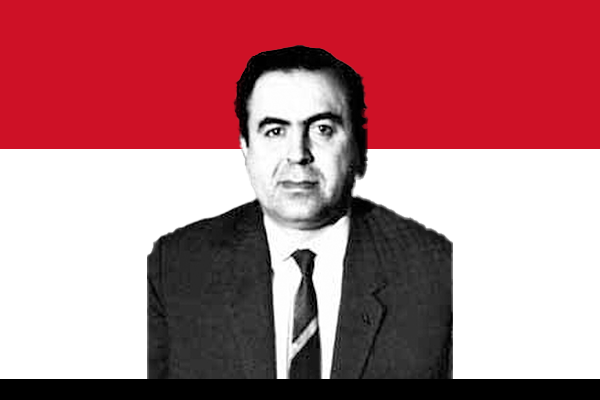
Nureddin Mustafa Ali al‑Atassi (11 January 1929 – 3 December 1992) was a Syrian politician, Ba’ath Party ideologue, and statesman who played a central role in Syria’s tumultuous politics during the 1960s. Born into the notable Al‑Atassi family in Homs, he trained as a medical doctor before entering full‑time political life, aligning himself with the Arab Socialist Ba’ath Party’s vision of Arab unity, socialism, and independence from colonial influence.
Atassi’s political career began with active involvement in civic organizations and nationalist movements aimed at strengthening Syria’s sovereignty following the end of French rule. His background as a physician included service in the Algerian War of Independence, where he provided medical assistance to Algerian fighters, underscoring his early commitment to anti‑imperialist causes. Upon returning to Syria, he practiced surgery in Damascus before fully transitioning into politics.
The Ba’ath Party’s rise to power in the March 1963 coup brought Atassi into high government office. He initially served as Minister of the Interior and later as Deputy Prime Minister. As internal divisions emerged within the party between civilian ideologues and military figures, Atassi became a key representative of the civilian wing. In February 1966, following a coup within the Ba’ath Party itself, he was appointed Secretary‑General of the Ba’ath Party and President of Syria.
Although holding the titles of head of state and party leader, Atassi was often regarded as a figurehead, with real power exercised by his deputy, Salah Jadid, a fellow Ba’athist with strong influence over the party’s military faction. Under Atassi’s presidency, Syria pursued ambitious economic and social projects and strengthened ties with the Soviet Union, including cooperation on infrastructure initiatives such as the Euphrates Dam. Domestically, his government implemented measures aimed at land reform and the expansion of state institutions.
Atassi’s tenure was dominated by the broader Arab Cold War context and the fallout from the 1967 Six‑Day War with Israel. During this period, he became the first Syrian leader to address the United Nations General Assembly after the conflict, attempting to rally international support for Syria and the Arab cause. The government also adopted staunch solidarity with Palestinian movements and took actions such as threatening military intervention in Jordan during the Black September conflict, reflecting its commitment to pan‑Arabism.
In addition to foreign policy activism, Atassi’s administration restructured state security mechanisms, founded new economic and legislative bodies, and sought to reinforce governmental control amid rising internal tensions. However, factional disputes between the Ba’ath Party’s civilian and military wings intensified, weakening his grip on power.
By late 1970, the balance of power tilted decisively toward the military faction led by Defense Minister Hafez al‑Assad. On 13 November 1970, Assad launched the so‑called “Corrective Movement,” effectively deposing Atassi and consolidating his own control over Syrian politics. After his removal from office, Atassi was imprisoned and later placed under house arrest. He remained in detention for over two decades before being released in poor health and allowed to travel to France for medical treatment, where he died in December 1992 at age 63.
Nureddin al‑Atassi’s legacy is intertwined with a critical period in Syria’s modern history—a time of ideological fervor, regional conflict, and dramatic shifts in political power. His career reflects both the aspirations and the internal fault lines of the Ba’athist experiment in governing a deeply divided society amid intense regional pressures.