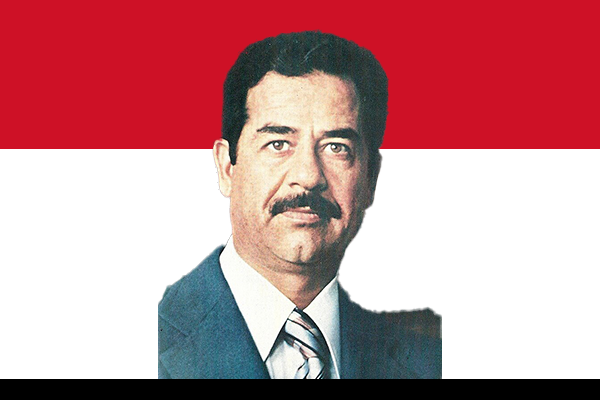
Early Life and Education
Saddam Hussein was born on April 28, 1937, in Al-Awja, a small village near Tikrit, Iraq. His early years were marked by poverty and hardship after his father’s death, which forced his mother to raise him in a challenging environment. Despite these obstacles, Saddam showed early intelligence and ambition. He attended local schools before moving to Baghdad for further education, where he was exposed to nationalist and political ideologies that would shape his future.
Entry into Politics
Saddam Hussein joined the Arab Socialist Ba’ath Party in 1957, drawn by its ideology of Arab nationalism, socialism, and anti-imperialism. He quickly gained a reputation as a shrewd and determined political operator, participating in party activities and contributing to the organization’s strategies. Saddam’s role in the failed assassination attempt against then-Prime Minister Abd al-Karim Qasim in 1959 forced him into exile in Egypt, where he continued his political training and forged alliances that would later prove crucial in his rise to power.
Rise to Vice Presidency
Returning to Iraq in the late 1960s, Saddam Hussein became a key figure in the Ba’ath Party’s successful 1968 coup, which brought Ahmed Hassan al-Bakr to the presidency. Recognized for his organizational skills and ruthless efficiency, Saddam was appointed as Vice President of Iraq, where he oversaw critical security, intelligence, and administrative functions. In this role, he established a network of loyalists and expanded the authority of the presidency, ensuring that the state apparatus operated firmly under his control.
Consolidation of Power
During his tenure as Vice President, Saddam Hussein systematically eliminated political rivals and potential threats. He restructured the Iraqi military and intelligence services, creating a tightly controlled security apparatus that reinforced his influence. Saddam’s policies strengthened Iraq’s centralized government, and he increasingly directed both domestic and foreign policies behind the scenes. By the late 1970s, his grip on power was so firm that he effectively became the de facto ruler, even before officially assuming the presidency in 1979.
Political Strategies and Governance
As Vice President, Saddam Hussein demonstrated remarkable political acumen. He used propaganda, state-controlled media, and patronage networks to build public support while maintaining a climate of fear for opposition. His ability to navigate party politics and governmental structures allowed him to consolidate power efficiently. Internationally, he positioned Iraq as a key player in the Middle East, balancing relationships with neighboring states and navigating complex geopolitical tensions.
Legacy and Controversy
Saddam Hussein’s time as Vice President laid the foundation for his authoritarian rule as President of Iraq. His policies and methods, marked by centralization, strict control, and suppression of dissent, left a lasting imprint on Iraqi politics. While some view him as a strong leader who stabilized the state, others criticize his regime for human rights abuses, political repression, and the use of violence to maintain authority. His early years as Vice President reveal the strategic planning and political maneuvering that defined his decades-long leadership.
Conclusion
Vice President Saddam Hussein played a crucial role in shaping modern Iraq’s political landscape. His rise from a small village to a position of national power illustrates a combination of ambition, intelligence, and strategic ruthlessness. By the time he became President, Saddam had already mastered the mechanisms of governance and control, setting the stage for his controversial and powerful legacy in Iraqi and Middle Eastern history.