AZERBAIJAN
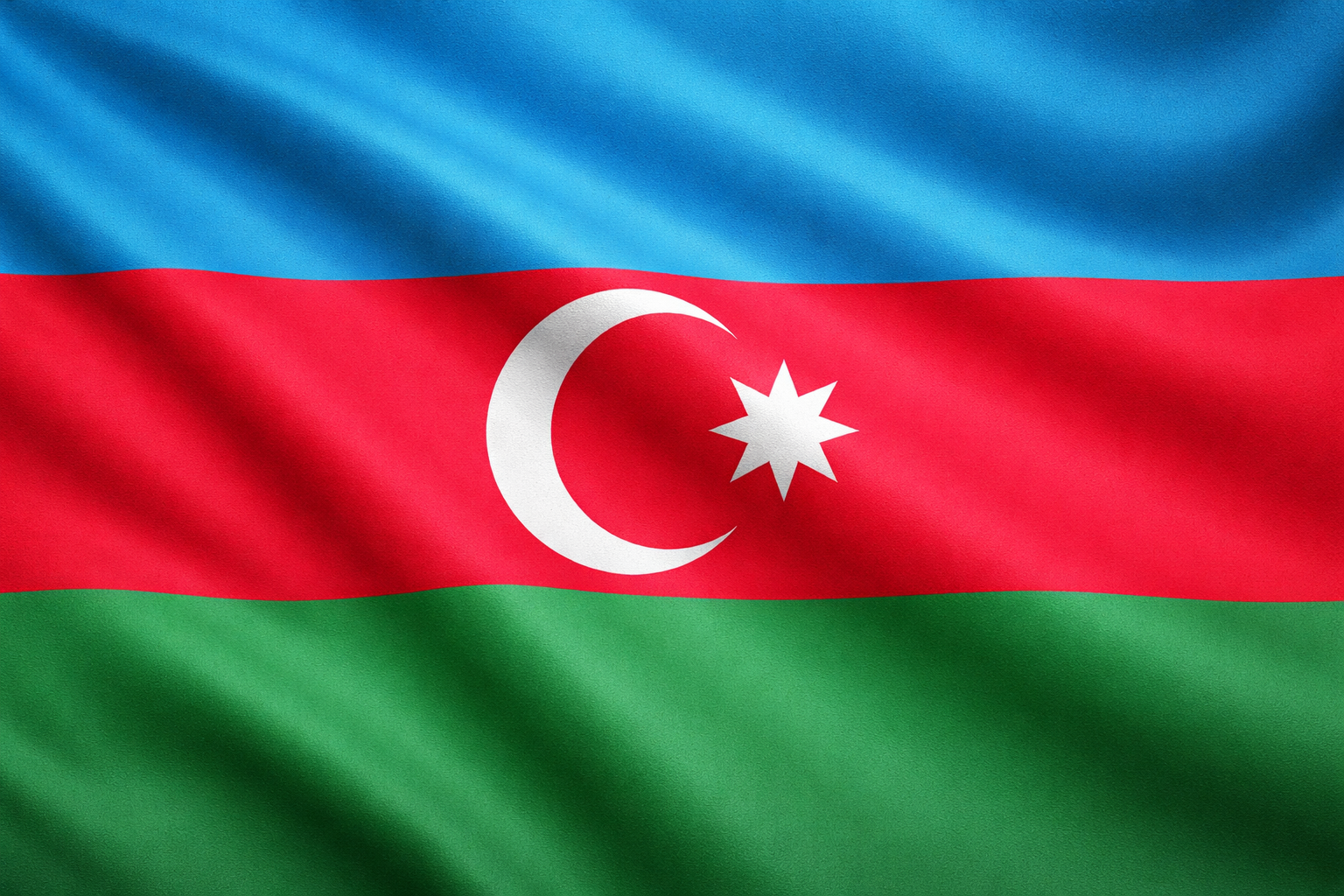
Azerbaijan Flag
The flag of Azerbaijan features three horizontal stripes of blue, red, and green. The blue stripe represents the Turkic heritage of the Azerbaijani people, while red symbolizes progress, modernization, and democracy. The green stripe reflects Islam and the nation’s cultural identity. At the center of the red band appears a white crescent and an eight-pointed star, symbolizing unity, Turkic peoples, and national independence.
Azerbaijan: A Land of History, Culture, and Energy
Azerbaijan is a country located at the crossroads of Eastern Europe and Western Asia, along the western coast of the Caspian Sea. Known as the “Land of Fire,” Azerbaijan has a rich history, diverse culture, and significant natural resources that have shaped its identity over centuries. Its strategic location has made it an important bridge between civilizations, trade routes, and cultures.
Geography and Natural Features
Azerbaijan shares borders with Russia to the north, Georgia to the northwest, Armenia to the west, Iran to the south, and the Caspian Sea to the east. The country features a varied landscape that includes mountains, plains, semi-deserts, and a long coastline. The Greater Caucasus Mountains dominate the northern region, while fertile lowlands support agriculture in central areas. Azerbaijan is also famous for its natural phenomena such as mud volcanoes and eternal flames caused by underground gas, reinforcing its ancient association with fire.
Historical Background
The history of Azerbaijan dates back thousands of years. It has been influenced by Persian, Greek, Roman, Arab, Turkic, and Russian civilizations. During ancient and medieval times, it served as a key stop on the Silk Road, facilitating trade and cultural exchange. In the 19th century, Azerbaijan became part of the Russian Empire and later the Soviet Union. Following the collapse of the USSR, Azerbaijan regained its independence in 1991 and began building its modern state.
Culture and Society
Azerbaijani culture reflects a blend of Eastern and Western traditions. The official language is Azerbaijani, a Turkic language, and the majority of the population practices Islam, mainly Shia, with strong traditions of tolerance and multiculturalism. Music, especially mugham, plays a central role in cultural life, along with traditional dance, poetry, and carpet weaving. Azerbaijani cuisine is known for its rich flavors, featuring dishes like plov, dolma, and kebabs.
Economy and Energy Resources
Azerbaijan’s economy is heavily influenced by its vast oil and natural gas reserves. The country has been an important energy producer since the late 19th century, particularly around the capital city, Baku. Energy exports have fueled economic growth and infrastructure development. In recent years, Azerbaijan has also focused on diversifying its economy by investing in agriculture, tourism, transport, and renewable energy.
Modern Azerbaijan
Today, Azerbaijan is a republic with Baku as its capital and largest city. It plays an active role in regional politics and international organizations. Modern Azerbaijan combines rapid urban development with deep respect for tradition, making it a country where ancient heritage and contemporary progress exist side by side.