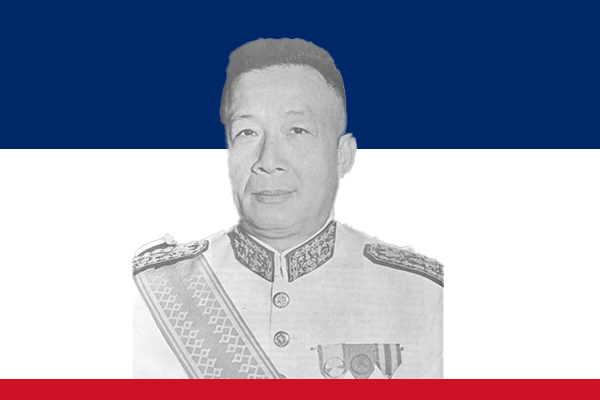
Sisavang Vatthana
Reign: 29 October 1959 – 2 December 1975
Home State: Luang Prabang
Lifespan: 1959–1975
Country: Laos
Image credits available here.
Early Life and Education
Born on 13 November 1907 in Luang Prabang, Sisavang Vatthana was the son of King Sisavang Vong. From an early age, he was prepared for national leadership. He received a modern education, including studies in France, where he gained exposure to Western political systems, constitutional governance, and diplomacy. This education later influenced his approach to leadership, particularly his preference for moderation and constitutional processes rather than authoritarian rule.
Ascension to National Leadership
Sisavang Vatthana ascended the throne in 1959 following the death of his father. At the time, Laos was a constitutional monarchy with an elected government headed by a Prime Minister. While executive power rested with the Prime Minister and cabinet, the King remained a central figure in state affairs, national unity, and diplomatic legitimacy. Sisavang Vatthana worked closely with successive Prime Ministers, often acting as a stabilizing influence amid frequent government changes.
Role During Political Instability
The 1960s and early 1970s were marked by intense political instability in Laos. The country became a battleground for competing ideologies during the Cold War, involving royalists, neutralists, and the communist Pathet Lao movement. Although Sisavang Vatthana did not govern directly like a Prime Minister, his constitutional role required him to appoint Prime Ministers, approve governments, and represent national continuity.
Throughout this period, Sisavang Vatthana consistently supported coalition governments and reconciliation efforts. He believed that compromise was essential to preserving national independence and preventing further bloodshed. His endorsement of neutralist policies demonstrated his commitment to peace, even as external pressures from regional and global powers intensified.
Relationship with Prime Ministers
Sisavang Vatthana maintained formal and respectful relationships with various Prime Ministers, including figures from royalist and neutralist factions. While he rarely intervened openly in policy-making, his moral authority and symbolic position carried weight. Many Prime Ministers viewed royal approval as essential for legitimacy, especially in times of crisis. In this sense, his influence, though indirect, shaped the political direction of Laos.
Fall of the Monarchy
In 1975, following the victory of the Pathet Lao and the withdrawal of foreign influence from Indochina, the monarchy was abolished. Sisavang Vatthana peacefully abdicated, avoiding civil conflict at a moment of historic transition. He and his family were subsequently placed in re-education camps, where he spent the remainder of his life. He died in captivity in the late 1970s, marking a tragic end to a reign defined by restraint rather than resistance.
Legacy and Historical Assessment
Sisavang Vatthana is remembered as a dignified and tragic figure in Lao history. Though not a Prime Minister, his leadership overlapped closely with the executive governments of his time. Historians often describe him as a constitutional monarch who sought unity, legality, and peace in an era dominated by ideological conflict. His refusal to rule by force and his acceptance of political change reflect a leadership style rooted in responsibility rather than power.