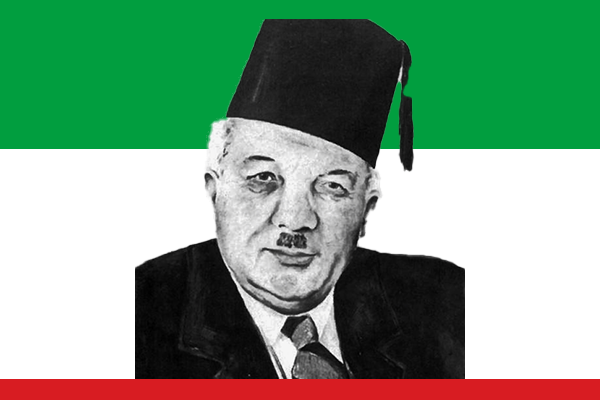
Riad El Solh was one of the most important political leaders in Lebanon’s modern history and played a central role in the country’s independence. Born in 1894 in Sidon, then part of the Ottoman Empire, El Solh came from a well-known Sunni Muslim family deeply involved in politics. His father, Reda El Solh, was also a prominent political figure, which influenced Riad’s early interest in public affairs and national movements.
El Solh received his education in Beirut and later continued his studies in law and political science in Paris. During his youth, he became involved in Arab nationalist movements that sought independence from Ottoman and later French rule. After the collapse of the Ottoman Empire following World War I, Lebanon came under French mandate. El Solh strongly opposed foreign control and worked actively to promote Arab unity and Lebanese sovereignty.
Throughout the 1920s and 1930s, Riad El Solh became increasingly involved in Lebanese politics. He built alliances across different religious communities, understanding that Lebanon’s stability depended on cooperation between Christians and Muslims. His political approach was based on compromise and dialogue, which later became essential in shaping the newly independent Lebanese state.
In 1943, Lebanon reached a turning point. Riad El Solh became Prime Minister under President Bechara El Khoury. Together, they played a decisive role in securing Lebanon’s independence from France. The same year, Lebanese leaders amended the constitution to remove articles that gave France special powers. In response, French authorities arrested El Solh, President El Khoury, and other government officials in November 1943 and imprisoned them in Rashaya Fortress.
The arrests caused widespread protests across Lebanon. People from all religious backgrounds united in demanding the release of their leaders and full independence. Due to internal pressure and international support, the French authorities released the imprisoned leaders on November 22, 1943. This date is now celebrated as Lebanon’s Independence Day. Riad El Solh’s leadership during this critical moment made him a national hero.
One of El Solh’s most significant achievements was the formation of the National Pact in 1943. The National Pact was an unwritten agreement between Christian and Muslim leaders that defined Lebanon’s political system. According to the agreement, the President would be a Maronite Christian, the Prime Minister a Sunni Muslim, and the Speaker of Parliament a Shia Muslim. The pact also balanced Lebanon’s Arab identity with its unique political and cultural character. This system aimed to maintain unity in a country with diverse religious communities.
Riad El Solh served as Prime Minister from 1943 to 1945 and again from 1946 to 1951. During his terms, he focused on strengthening state institutions, improving Lebanon’s international relations, and supporting economic growth. He also promoted Lebanon’s role in the Arab world and participated in the formation of the Arab League in 1945.
However, his time in office was not without challenges. Lebanon faced political tensions, economic difficulties, and disagreements among different groups. Some critics accused his government of corruption and favoritism, which led to political opposition. Despite these difficulties, El Solh remained a key figure in shaping Lebanon’s early years as an independent state.
Tragically, Riad El Solh’s life ended in violence. On July 16, 1951, he was assassinated in Amman, Jordan, by a member of the Syrian Social Nationalist Party. His assassination shocked Lebanon and the wider Arab world. He was remembered as a symbol of independence and national unity.
Today, Riad El Solh is honored as one of the founding fathers of modern Lebanon. Riad El Solh Square in downtown Beirut stands as a tribute to his legacy. His efforts to promote cooperation among Lebanon’s diverse communities continue to influence the country’s political system. His dedication to independence and national unity remains a defining chapter in Lebanese history.