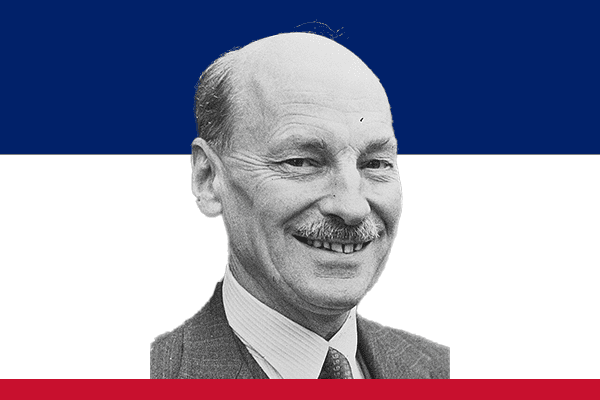
Mr. Clement Attlee
In Office: 26 July 1945 – 26 October 1951
Political Party: Labour
Home State: Putney
Lifespan: 1883–1967
Country: United Kingdom
Image credits available here.
Early Life and Political Career
Clement Richard Attlee was born on January 3, 1883, in London. He studied at University College Oxford and later trained as a lawyer. However, his experiences working in impoverished communities in London greatly influenced his political views. Attlee became increasingly committed to social reform and joined the Labour movement.
During World War I, Attlee served in the British Army and reached the rank of major. After the war, he entered Parliament as a Labour Member of Parliament in 1922. Over the following years, he built a reputation as a thoughtful and disciplined politician. In 1935, Attlee became leader of the Labour Party and led the party through difficult years while it remained in opposition.
Prime Ministership (1945–1951)
In 1945, Britain held a general election shortly after the end of World War II. The Labour Party, under Attlee’s leadership, won a landslide victory over the Conservatives led by Winston Churchill. Attlee became Prime Minister and immediately began implementing a wide-ranging program of reforms.
His government focused on rebuilding Britain after the war and improving living conditions for ordinary citizens. One of the most significant achievements of Attlee’s administration was the creation of the National Health Service in 1948. This system provided free healthcare to all citizens and became one of the most important pillars of the British welfare state.
Attlee’s government also nationalized several major industries, including coal, railways, and steel, to improve efficiency and public access. In addition, the government introduced major social welfare reforms inspired by the Beveridge Report. These reforms expanded social security, unemployment benefits, and housing programs.
Foreign Policy and Decolonization
Attlee also played a key role in shaping Britain’s postwar foreign policy. His government supported the creation of the United Nations and helped establish the North Atlantic Treaty Organization.
Another major development during Attlee’s tenure was the process of decolonization. In 1947, Britain granted independence to India and Pakistan. This decision marked a turning point in the history of the British Empire and paved the way for independence movements in other colonies.
Legacy
Clement Attlee’s leadership significantly transformed the United Kingdom. His government created institutions and social policies that improved healthcare, education, and social security. Despite his quiet personality and modest style, Attlee proved to be a highly effective leader who implemented lasting reforms.
Historians often regard Attlee as one of Britain’s most influential prime ministers. His commitment to social equality and democratic governance helped shape modern Britain. Even decades later, many of the institutions established during his administration continue to serve the British people and remain central to the country’s political and social framework.