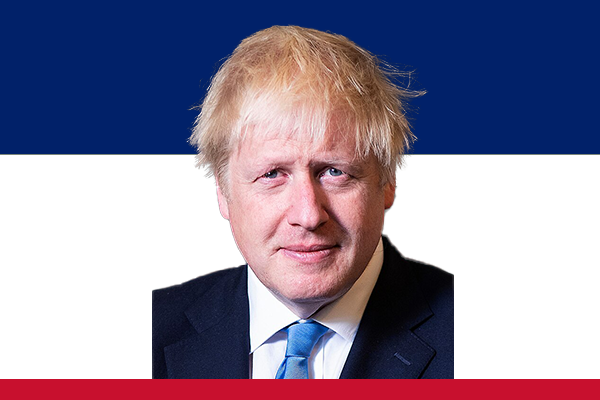
Mr. Boris Johnson
In Office: 24 July 2019 – 6 September 2022
Political Party: Conservative
Home State: Marylebone
Lifespan: born 1964
Country: United Kingdom
Image credits available here.
Early Life and Education
Alexander Boris de Pfeffel Johnson was born on June 19, 1964, in New York City, United States. His family later moved to the United Kingdom, where he grew up and completed most of his education. Johnson attended the prestigious Eton College and later studied Classics at Balliol College, Oxford. At Oxford University, he developed strong debating skills and actively participated in student politics. These experiences helped build the communication style that later defined his political career.
Career in Journalism
Before entering politics, Johnson worked as a journalist. He wrote for several newspapers and gained recognition as a political commentator. He worked as a correspondent for The Daily Telegraph and later became editor of The Spectator magazine. His writing style mixed humor with strong political opinions, which helped him gain public attention and build a reputation in British media.
Entry into Politics
Johnson entered active politics when he won a seat as a Member of Parliament (MP) for Henley in 2001. During his early years in Parliament, he served in various roles within the Conservative Party. He often appeared in television debates and political programs, where he demonstrated his energetic speaking style and strong personality.
His popularity grew significantly when he ran for Mayor of London. In 2008, voters elected him as Mayor, and he served two terms until 2016. During his time as mayor, Johnson supported major infrastructure projects, including the expansion of public transportation and preparations for the 2012 London Olympic Games.
Role in the Brexit Movement
Johnson played a major role in the campaign for the United Kingdom to leave the European Union. In 2016, he became one of the most visible supporters of the “Leave” campaign during the Brexit referendum. The campaign succeeded when a majority of British voters chose to leave the EU.
After the referendum, Prime Minister Theresa May appointed Johnson as the Foreign Secretary in 2016. In this role, he represented the United Kingdom in international diplomacy and global political discussions. However, disagreements over Brexit strategy led him to resign from the position in 2018.
Becoming Prime Minister
In July 2019, Johnson won the Conservative Party leadership contest and became Prime Minister. He promised to complete Brexit and finalize the United Kingdom’s exit from the European Union. His government negotiated a revised withdrawal agreement, and the UK officially left the EU on January 31, 2020.
Later in 2019, Johnson called a general election to strengthen his government. The Conservative Party won a large parliamentary majority, which gave him strong political authority to pursue his policies.
Leadership During the COVID-19 Pandemic
Johnson faced one of the biggest challenges of his leadership when the COVID-19 pandemic spread across the world in 2020. His government introduced nationwide lockdowns, vaccination programs, and economic support measures. These policies aimed to protect public health and support businesses during the crisis.
Johnson himself contracted COVID-19 in April 2020 and required hospitalization. After recovering, he continued to lead the government’s response to the pandemic and supported one of the fastest vaccination campaigns in Europe.
Controversies and Resignation
Despite political successes, Johnson’s leadership also faced criticism and controversy. Several political scandals and internal party disagreements weakened his support within the Conservative Party. Many government officials and ministers resigned in 2022, which created strong pressure for him to step down.
In July 2022, Johnson announced his resignation as leader of the Conservative Party. He continued to serve as Prime Minister until a new leader took office in September 2022.
Legacy
Boris Johnson remains a significant figure in modern British politics. His leadership oversaw the completion of Brexit and guided the country through the global pandemic. Supporters praise his energetic leadership and political communication, while critics highlight the controversies that marked his time in office. Regardless of differing opinions, Johnson’s influence on the United Kingdom’s recent political history remains undeniable.