MALAYSIA
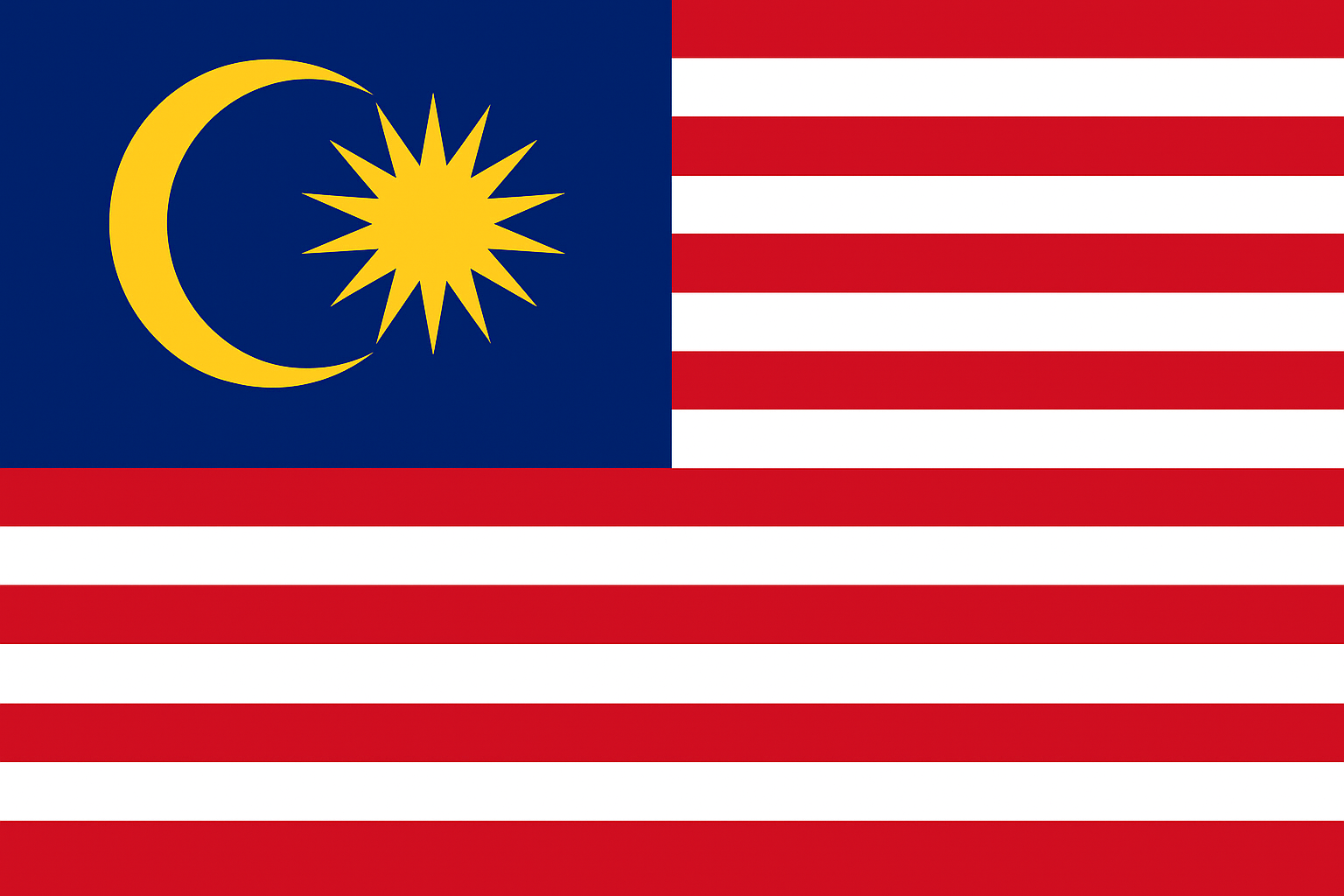
Malaysia Flag
The national flag of Malaysia is called Jalur Gemilang, meaning “Stripes of Glory.” It features 14 red and white horizontal stripes representing equality among the states and the federal government. The blue canton symbolizes unity, while the yellow crescent and 14-pointed star represent Islam as the official religion and the unity of the nation. Yellow is the royal color, reflecting the authority of Malaysia’s monarch.
Overview
Introduction
Malaysia is a Southeast Asian country known for its rich cultural diversity, strategic location, and rapid economic development. Located partly on the Malay Peninsula and partly on the island of Borneo, Malaysia blends tradition with modernity. Its multicultural society, stable governance, and growing economy make it an important nation in the Asian region.
Geography and Natural Features
Malaysia is divided into Peninsular Malaysia and East Malaysia (Sabah and Sarawak), separated by the South China Sea. The country is blessed with tropical rainforests, long coastlines, mountains, and fertile plains. Malaysia’s climate is equatorial, characterized by high humidity and regular rainfall, which supports rich biodiversity. It is home to some of the world’s oldest rainforests and unique wildlife.
History and Formation
Malaysia’s history reflects centuries of trade, colonization, and cultural exchange. Influenced by Malay sultanates, Chinese and Indian traders, and later European colonial powers, the country developed a unique identity. After periods of Portuguese, Dutch, and British rule, Malaysia gained independence in 1957. In 1963, Sabah and Sarawak joined the federation, forming modern Malaysia.
Political System and Governance
Malaysia follows a constitutional monarchy system with a parliamentary democracy. The head of state is the Yang di-Pertuan Agong, elected from among the Malay rulers, while executive power lies with the Prime Minister and Cabinet. This system balances traditional monarchy with democratic governance, ensuring political stability and continuity.
Culture and Society
Malaysia is famous for its multicultural society, made up mainly of Malays, Chine, India, and indigenous communities. This diversity is reflected in languages, religions, festivals, clothing, and food. Islam is the official religion, but freedom of worship is guaranteed. Celebrations such as Hari Raya, Chinese New Year, Deepavali, and Christmas highlight peaceful coexistence among communities.
Economy and Development
Malaysia has transformed from an agriculture-based economy into a modern industrial and service-driven economy. It is a major producer of palm oil, rubber, and electronics. The country has also become a hub for tourism, finance, and manufacturing. Government initiatives and foreign investment have supported infrastructure development and technological growth.
Education and Modern Progress
Education plays a vital role in Malaysia’s progress. The country has invested in schools, universities, and vocational training to develop skilled human resources. Urban centers like Kuala Lumpur showcase modern skyscrapers, efficient transport systems, and digital innovation, symbolizing Malaysia’s ambition for global competitiveness.
Conclusion
Malaysia stands as a nation that successfully combines tradition with progress. Its cultural harmony, political stability, and economic growth reflect a strong national identity. With continued development and unity among its people, Malaysia remains an important and influential country in Southeast Asia.