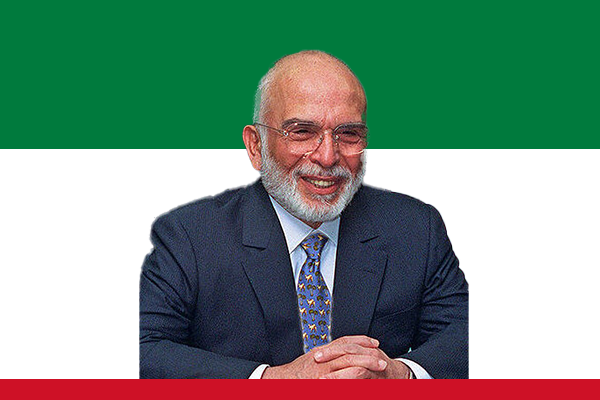
Early Life and Ascension to the Throne
Hussein bin Talal was born on 14 November 1935 in Amman into the Hashemite royal family. He was the grandson of King Abdullah I, the founder of modern Jordan. After the assassination of King Abdullah I in 1951, Hussein’s father, King Talal, ascended the throne but abdicated due to health reasons. As a result, Hussein became king in 1952 at the young age of 16 and formally assumed constitutional powers in 1953. His early accession placed immense responsibility on a young monarch still completing his education.
Consolidating Power and Internal Stability
During the early years of his reign, King Hussein faced political instability, economic hardship, and ideological pressures from Arab nationalism. He worked to consolidate authority by strengthening state institutions and maintaining a balance between traditional tribal loyalties and modern governance. Hussein emphasized national unity and upheld the monarchy as a symbol of continuity and legitimacy. His ability to survive coup attempts and political unrest demonstrated his political acumen and determination.
Role in Regional Conflicts
King Hussein’s reign coincided with several major Arab Israeli conflicts. Jordan participated in the 1967 Six-Day War, which resulted in the loss of the West Bank and East Jerusalem. This defeat posed a severe challenge to Jordan’s economy and national morale. In 1970, the country experienced internal conflict during the events known as Black September, when the Jordanian state confronted armed Palestinian groups to reassert sovereignty. Hussein’s decisive actions ensured the survival of the Jordanian state, though at significant political and human cost.
Foreign Policy and Peace Efforts
One of King Hussein’s defining characteristics was his pragmatic and moderate foreign policy. He sought balanced relations with Western powers, Arab states, and neighboring countries. Hussein played a crucial role in promoting dialogue and diplomacy, believing that peace was essential for regional stability. His most notable achievement came in 1994 when Jordan signed a peace treaty with Israel, formally ending decades of hostility. This decision demonstrated political courage and reinforced Jordan’s international standing.
Economic and Social Development
Throughout his reign, King Hussein prioritized development despite limited natural resources. He supported education, infrastructure, and healthcare as pillars of national progress. Universities, roads, and public institutions expanded significantly under his leadership. Hussein also encouraged gradual political participation, allowing parliamentary life to continue even during difficult periods. His approach aimed to modernize the state while respecting Jordan’s social and cultural traditions.
Personal Character and Leadership Style
King Hussein was widely admired for his humility, accessibility, and deep sense of duty. He maintained close contact with citizens and often traveled across the country to understand public concerns. His leadership style blended firmness with compassion, earning him loyalty across diverse segments of society. Even critics acknowledged his dedication to Jordan’s survival and independence.
Legacy and Historical Significance
King Hussein bin Talal passed away on 7 February 1999, leaving behind a stable kingdom and a respected international reputation. His legacy lives on through the institutions he strengthened and the diplomatic path he forged. Remembered as a unifying figure, King Hussein shaped modern Jordan and secured its place as a key moderating force in the Middle East.