Prithvi Narayan Shah
Coronation: 25 September 1768
Reign: 25 September 1768 – 11 January 1775
Home State: Gorkha
Lifespan: 1723–1775
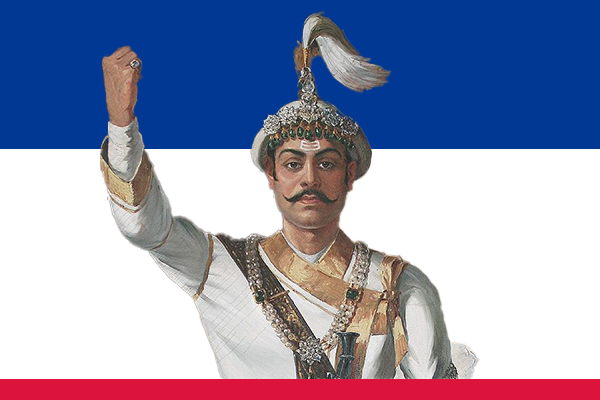
Early Life and Background
King Prithvi Narayan Shah was born on January 11, 1723, in Gorkha, Nepal, to King Nara Bhupal Shah and Queen Kaushalyavati Devi. From an early age, he displayed a strong interest in statecraft, military strategy, and governance. As the eldest son, he prepared himself for leadership by studying political affairs and observing regional powers.
Ascension to the Throne
Prithvi Narayan Shah ascended the throne of Gorkha in 1743 after the death of his father. He immediately envisioned a unified Nepal, free from foreign interference. He understood the importance of Kathmandu Valley as a political and economic hub, so he set his eyes on conquering it.
Military Campaigns and Unification
Under his leadership, the Gorkha army launched strategic campaigns to capture surrounding kingdoms. He expanded his forces, improved weaponry, and trained his soldiers in disciplined warfare. By combining military power with diplomacy, he persuaded some states to join him while defeating others in battle. His most notable achievement came in 1769 when he captured Kathmandu, thus laying the foundation of modern Nepal.
Prithvi Narayan Shah implemented the policy of “Divine Country,” aiming to protect Nepal from colonial powers. He famously declared Nepal as a “yam between two boulders,” referring to its position between China and India, and urged future rulers to maintain balanced foreign relations.
Administrative Reforms
Beyond military conquest, King Prithvi Narayan Shah introduced reforms that strengthened governance and improved the economy. He encouraged local trade, controlled corruption, and ensured fair taxation. He promoted self-sufficiency, discouraging unnecessary imports and emphasizing domestic production.
Visionary Leadership
He worked tirelessly to foster unity among diverse ethnic groups in Nepal. He valued cultural heritage, supported religious harmony, and treated all subjects with fairness. His leadership style combined firm authority with a deep commitment to his people’s welfare.
Legacy
King Prithvi Narayan Shah passed away on January 11, 1775, in Nuwakot. By the time of his death, he had successfully unified many small kingdoms into a single, stronger nation. His vision, policies, and strategies continue to inspire Nepal’s political philosophy. Today, he is honored as the founder of modern Nepal and celebrated every year on Prithvi Jayanti.