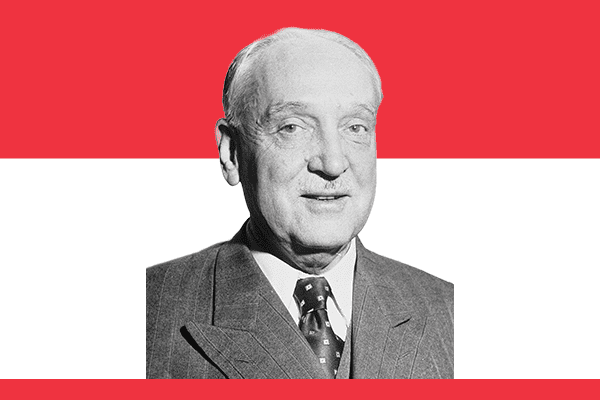
Early Life and Education
Adolf Schärf was born on April 20, 1890, in Nikolsburg, which was then part of the Austro-Hungarian Empire (now in the Czech Republic). He grew up in a modest family and developed an early interest in politics and law. He pursued higher education at the University of Vienna, where he studied law and built a strong intellectual foundation for his future political career.
After completing his studies, Schärf began practicing law and soon became involved in socialist politics. He actively participated in workers’ movements and supported policies that aimed to improve social justice and equality.
Political Career Before World War II
Schärf joined the Social Democratic Workers’ Party of Austria and quickly rose through its ranks. During the First Austrian Republic, he served as a member of the National Council. He advocated democratic reforms and worked to protect the rights of workers and citizens.
However, political instability and the rise of authoritarianism disrupted Austria’s democracy in the 1930s. When the Austrofascist regime banned the Social Democratic Party in 1934, Schärf faced political repression. Despite these challenges, he remained committed to democratic ideals.
Role During and After World War II
During World War II, Schärf stayed in Austria and avoided collaboration with the Nazi regime. After the war ended in 1945, he played a key role in re-establishing Austria’s political system. He helped reorganize the Social Democratic Party, which became the Socialist Party of Austria (SPÖ).
Schärf actively contributed to forming a coalition government with other major political parties. This cooperation helped stabilize the country and rebuild its economy and institutions. He served as Vice Chancellor of Austria from 1945 to 1957, where he worked closely with other leaders to guide Austria through reconstruction.
Presidency
In 1957, Adolf Schärf became the President of Austria. During his presidency, he focused on maintaining political stability and strengthening Austria’s international position. He supported Austria’s policy of neutrality, which became a cornerstone of the nation’s foreign policy during the Cold War.
Schärf engaged actively in diplomatic relations and represented Austria on the global stage. He ensured that the presidency remained a unifying force above party politics. His leadership style emphasized cooperation, moderation, and national unity.
Leadership Style and Contributions
Adolf Schärf led with pragmatism and dedication. He believed in consensus-building and worked to bridge political divides. Instead of adopting extreme positions, he encouraged dialogue and compromise among different political groups.
He contributed significantly to Austria’s democratic development by reinforcing constitutional governance and political stability. His efforts helped transform Austria into a stable and prosperous democracy after the devastation of war.
Personal Life and Legacy
Schärf maintained a relatively private personal life, focusing primarily on his political responsibilities. He earned respect for his integrity and commitment to public service.
He served as President until his death on February 28, 1965. His tenure marked a period of consolidation for Austria’s democracy. Today, many remember him as a key architect of Austria’s post-war recovery and political stability.
Conclusion
Adolf Schärf remains an important figure in Austrian history. He actively helped rebuild a nation, strengthen democratic institutions, and guide Austria through a challenging era. His leadership continues to serve as an example of dedication, cooperation, and responsible governance.