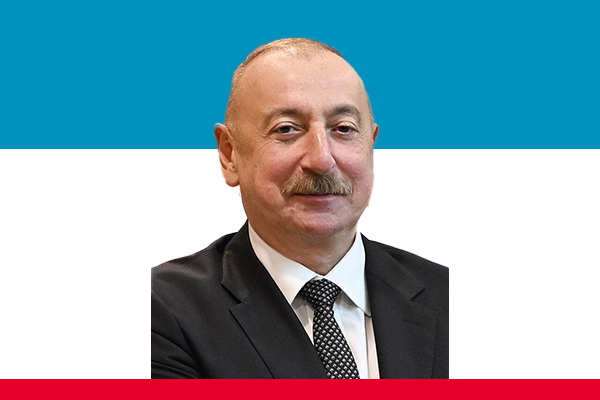
Mr. Ilham Aliyev
Assumed Office: 31 October 2003 – Incumbent
Political Party: New Azerbaijan Party
Home State: Baku
Lifespan: born 1961
Country: Azerbaijan
Image credits available here.
Early Life and Education
Ilham Heydar oglu Aliyev was born on December 24, 1961, in Baku, Azerbaijan. He grew up in a politically influential family; his father, Heydar Aliyev, served as the President of Azerbaijan from 1993 to 2003 and played a pivotal role in stabilizing the country after the collapse of the Soviet Union. Ilham Aliyev pursued higher education in Azerbaijan and later studied international relations at Moscow State University, earning a strong foundation in law and political science. This educational background equipped him with the skills necessary for a career in diplomacy and governance.
Political Rise
Ilham Aliyev began his political career in the early 1980s, working in various government roles. His rapid ascent was influenced by his father’s leadership and his own diplomatic acumen. In 1994, he became the Vice President of the State Oil Company of Azerbaijan (SOCAR), where he gained significant experience in the country’s critical oil and gas sector. By 1997, he was appointed as the head of the Department of Foreign Relations, and later, he joined the National Assembly, marking the start of his legislative involvement.
Presidency
Ilham Aliyev became the President of Azerbaijan in October 2003, following the resignation of his father. His election marked the continuation of the Aliyev family’s influence in Azerbaijani politics. Under his leadership, Azerbaijan has pursued a mix of economic modernization, infrastructural development, and energy diplomacy. Aliyev prioritized transforming Azerbaijan into a regional hub for energy exports, leveraging the nation’s abundant oil and natural gas reserves to strengthen international partnerships.
Economic Policies and Energy Development
President Aliyev has focused on economic diversification while maintaining the energy sector as the backbone of the national economy. He has overseen large-scale infrastructure projects, including the construction of highways, bridges, and urban development initiatives, which have modernized Baku and other cities. Aliyev’s administration has also invested in renewable energy and technological development, aiming to reduce the nation’s dependence on oil revenue over the long term.
Domestic Governance and Reforms
Aliyev’s tenure has been marked by both development and controversy. While he has implemented reforms in education, healthcare, and public services, critics have raised concerns about restrictions on press freedom and political opposition. Despite these challenges, his governance has maintained stability in Azerbaijan, allowing for consistent economic growth and improved international relations.
Foreign Policy and Regional Influence
Ilham Aliyev has strengthened Azerbaijan’s role on the global stage, particularly in energy diplomacy and regional security. He has maintained strategic partnerships with countries such as Turkey, Russia, and the United States while actively engaging in regional initiatives in the South Caucasus. His leadership during conflicts, including the 2020 Nagorno-Karabakh war, reinforced Azerbaijan’s territorial claims and shaped the nation’s defense strategy. Aliyev’s diplomatic approach emphasizes both national sovereignty and regional cooperation.
Legacy and Future Vision
President Ilham Aliyev’s legacy is intertwined with the modernization and global positioning of Azerbaijan. He continues to promote economic development, infrastructural investment, and strategic diplomacy, aiming to secure Azerbaijan’s role as a stable and influential nation in the region. As the country navigates global economic and political shifts, Aliyev’s vision remains focused on stability, growth, and international recognition.