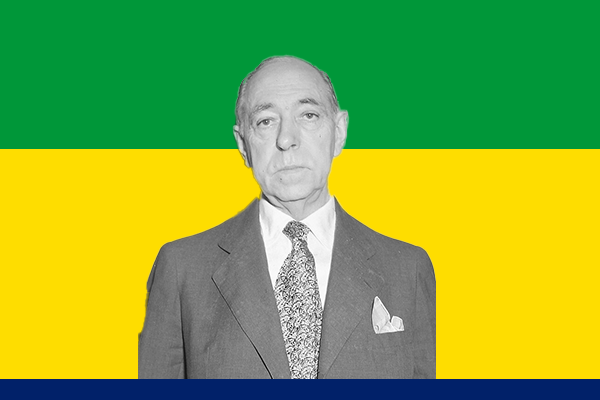
Early Life and Political Foundation
Nereu Ramos was born on September 3, 1888, in Lages, Santa Catarina, Brazil. Coming from a family deeply involved in politics, he grew up with a strong sense of civic responsibility. He studied law at the Faculty of Law of São Paulo, where he developed an understanding of governance and justice. His legal background inspired him to enter public service, where he aimed to modernize Brazil’s political framework.
Ramos began his political career as a member of the Legislative Assembly of Santa Catarina. His dedication to public administration earned him respect among colleagues and citizens alike. He joined the Liberal Party and quickly became a significant voice in state politics. By actively participating in legislative reforms, he gained recognition as a fair and pragmatic leader.
Rise to National Prominence
Ramos’s consistent advocacy for democracy and development elevated him to national prominence. He served as Governor of Santa Catarina, where he implemented policies that modernized infrastructure and improved education. His leadership style focused on negotiation and consensus-building, qualities that strengthened his reputation during politically unstable times.
Later, Ramos represented Santa Catarina in the Federal Senate. As a senator, he supported democratic institutions and worked to balance Brazil’s federal structure. His calm temperament and integrity helped him earn trust across party lines. His ability to mediate political conflicts later became essential during Brazil’s turbulent political period in the mid-1950s.
Presidency and Restoration of Constitutional Order
Nereu Ramos assumed the presidency of Brazil on November 11, 1955, after a political crisis threatened to destabilize the country. President Café Filho had been temporarily removed from office, and the military intervened to prevent potential unrest. As the President of the Senate, Ramos stood next in line according to the constitutional order. He accepted the responsibility with determination to preserve democracy and legality.
Once in office, Ramos worked to restore public confidence and stabilize the government. He convened political leaders, encouraged dialogue, and reaffirmed Brazil’s commitment to constitutional principles. His firm yet balanced leadership prevented further chaos. He ensured that the transition to President-elect Juscelino Kubitschek proceeded peacefully and lawfully.
Ramos’s short presidency—lasting until January 31, 1956—became a turning point in Brazilian politics. By adhering strictly to constitutional law, he demonstrated how democratic systems could survive crises through legal and institutional strength. His decisions reaffirmed the authority of civilian institutions over military influence.
Achievements and Leadership Style
Although his tenure was brief, Ramos achieved significant political stability. He reorganized administrative functions and promoted respect for democratic institutions. His ability to remain impartial during conflict allowed him to act as a unifying figure. Ramos prioritized the rule of law over personal ambition, showing his deep commitment to national interests.
He also encouraged cooperation between political parties to avoid further division. His leadership style emphasized prudence, dialogue, and national responsibility—qualities that solidified his legacy as a stabilizer rather than a disruptor.
Legacy and Death
After leaving the presidency, Ramos continued serving Brazil with integrity and dedication. He resumed his senatorial duties and remained a respected statesman. His tragic death in a plane crash on June 16, 1958, near Curitiba, ended a career marked by service and devotion to constitutional order.
Despite his short time as president, Nereu Ramos left a profound legacy. He proved that calm, lawful governance could preserve democracy even in moments of great uncertainty. His leadership reinforced the importance of constitutional loyalty and political stability in Brazil’s history.
Conclusion
President Nereu Ramos’s tenure symbolized the resilience of Brazilian democracy. He guided the nation through one of its most critical transitions with courage and wisdom. By choosing dialogue over confrontation and law over force, he safeguarded the country’s democratic path. His brief but impactful presidency remains a testament to the strength of constitutional governance and moral leadership in times of crisis.