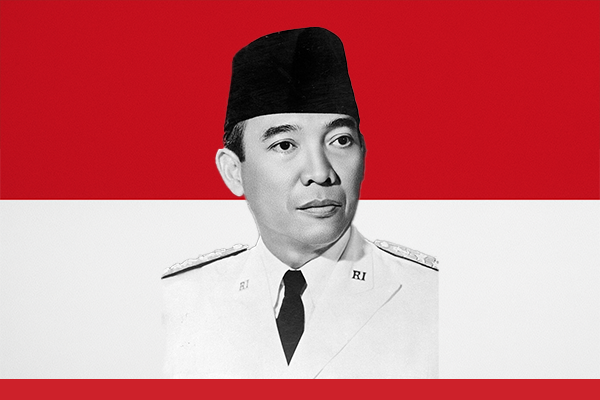
Early Life and Education
Sukarno was born on June 6, 1901, in Surabaya, Indonesia. His father, a civil engineer, influenced Sukarno’s interest in architecture and public life. He attended Dutch schools and eventually studied civil engineering at the Bandung Institute of Technology. During his studies, Sukarno became deeply involved in nationalist movements, forming connections with fellow activists who shared his vision for an independent Indonesia.
Rise as a Nationalist Leader
Sukarno actively promoted Indonesian nationalism in the 1920s and 1930s. He co-founded the Indonesian National Party (PNI) in 1927, advocating for independence from Dutch colonial rule. Dutch authorities arrested and exiled him multiple times, but he continued to inspire Indonesians with speeches and writings that emphasized unity, self-determination, and national pride.
Proclamation of Independence
Following the Japanese occupation during World War II, Sukarno, alongside Mohammad Hatta, proclaimed Indonesia’s independence on August 17, 1945. He took the role of Indonesia’s first president, assuming leadership during a volatile period. Sukarno immediately worked to consolidate the nation’s sovereignty, mobilizing political allies and negotiating with foreign powers to secure recognition of Indonesia’s independence.
Leadership and Policies
As president, Sukarno implemented policies aimed at unifying the diverse archipelago. He promoted Pancasila, the five principles forming the ideological foundation of the Indonesian state, which emphasized nationalism, internationalism, democracy, social justice, and belief in God. Sukarno also pursued guided democracy in the late 1950s, seeking to balance political factions while maintaining centralized authority. He used cultural initiatives, such as promoting Indonesian arts and heritage, to foster national identity.
Foreign Policy and Non-Alignment
Sukarno actively shaped Indonesia’s foreign policy, positioning the nation as a leader in the Non-Aligned Movement. He hosted the 1955 Bandung Conference, bringing together leaders from Asia and Africa to promote cooperation and resist colonial influence. His speeches encouraged anti-imperialism and solidarity among newly independent nations, earning him international recognition as a charismatic and influential statesman.
Economic and Social Challenges
Despite Sukarno’s visionary leadership, Indonesia faced economic and social challenges. Sukarno promoted large-scale infrastructure projects, but the country struggled with inflation, corruption, and political instability. He often relied on mass mobilization and charismatic leadership to maintain public support, but these strategies eventually strained the nation’s institutions and resources.
Decline and Legacy
By the mid-1960s, political unrest and economic difficulties weakened Sukarno’s rule. The military, under General Suharto, gradually took control, leading to Sukarno’s eventual removal from power in 1967. Despite his fall, Sukarno left an enduring legacy. Indonesians remember him as the father of the nation, a leader who fought for independence, inspired national unity, and championed a vision of Indonesia as a sovereign, culturally rich, and internationally respected country.
Conclusion
President Sukarno’s life demonstrates the power of vision, charisma, and determination. From his early activism to leading Indonesia to independence and shaping its early years, Sukarno’s leadership left an indelible mark on the nation. His dedication to national unity, cultural identity, and global cooperation continues to inspire Indonesians and leaders worldwide.