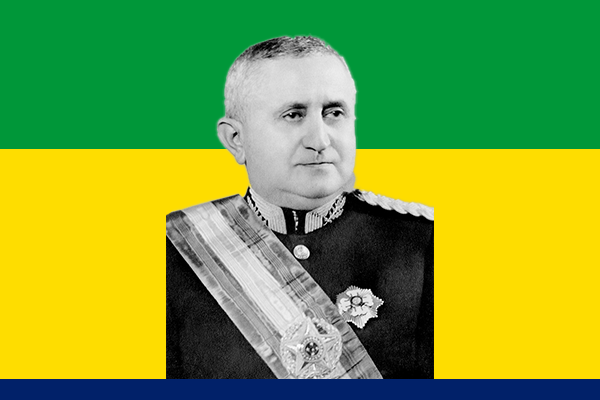
Early Life and Military Career
Eurico Gaspar Dutra was born on May 18, 1883, in Cuiabá, Brazil. From an early age, he showed discipline and determination, qualities that later shaped his military and political career. Dutra pursued military education at the prestigious Military Academy of Praia Vermelha, where he developed his leadership skills and strategic mindset. He climbed the ranks of the Brazilian Army through dedication, earning respect for his loyalty and professionalism. His military career prepared him to handle complex political and administrative challenges that awaited him later.
Rise to Political Prominence
Dutra entered national politics during a time of great change. When Getúlio Vargas came to power in 1930, Dutra joined his government and played a vital role in shaping defense and security policies. As Minister of War from 1936 to 1945, he strengthened the Brazilian Armed Forces and modernized the defense system. He maintained order during times of political unrest, ensuring that Brazil remained stable during World War II.
Dutra built his reputation as a disciplined and moderate leader who valued national unity above personal ambition. His loyalty to constitutional principles and commitment to Brazil’s sovereignty helped him earn the trust of both military and civilian leaders.
Election as President
In 1945, Brazil transitioned from dictatorship to democracy. Recognizing Dutra’s reputation for integrity and stability, political leaders supported his candidacy for the presidency. Backed by the Social Democratic Party (PSD) and the National Democratic Union (UDN), he won the election with broad support. On January 31, 1946, Dutra assumed office as President of Brazil, marking the beginning of a new democratic era.
Economic and Social Policies
As President, Dutra prioritized economic reconstruction after the global disruptions of World War II. He promoted industrial growth and encouraged foreign investment to modernize Brazil’s economy. His administration focused on building infrastructure, expanding roads, and improving communication networks to connect distant regions.
Dutra emphasized fiscal discipline and controlled inflation by implementing responsible financial policies. He guided Brazil toward economic stability by balancing imports and exports and encouraging the private sector. Under his leadership, Brazil joined the International Monetary Fund (IMF) and the World Bank, integrating more closely into the global economy.
Socially, Dutra supported education reforms and strengthened the role of civic institutions. He promoted family values, religion, and national pride as essential elements of Brazilian society. His government fostered social order and discipline, which he believed were necessary for progress.
Foreign Policy and Democratic Commitment
In foreign affairs, Dutra aligned Brazil with the Western bloc during the early years of the Cold War. He emphasized cooperation with the United States and other democratic nations, reflecting his strong anti-communist stance. He restored Brazil’s diplomatic relations with the Vatican and reinforced Brazil’s image as a reliable partner in the Americas.
Domestically, Dutra demonstrated his respect for democracy by maintaining free elections and upholding the 1946 Constitution. Although he governed firmly, he avoided authoritarian measures and worked to strengthen democratic institutions. His leadership helped rebuild Brazil’s confidence in constitutional government after years of political uncertainty.
Legacy and Later Years
Eurico Dutra completed his presidential term in 1951 and peacefully handed power back to Getúlio Vargas, marking a rare and significant moment in Brazilian political history. His calm and disciplined approach to governance left a lasting impression on Brazil’s political development.
After leaving office, Dutra retired from public life but continued to influence military and political circles through his example of integrity and order. He passed away on June 11, 1974, leaving behind a legacy of stability and reconstruction.
Conclusion
President Eurico Gaspar Dutra guided Brazil through a transformative period with firmness and dedication. He rebuilt the nation’s economy, reinforced democracy, and positioned Brazil as a respected member of the international community. His presidency symbolized discipline, stability, and faith in democratic values that continue to inspire Brazilian leaders today.