Mr. Alcide De Gasperi
In Office: 10 December 1945 – 17 August 1953
Political Party: Christian Democratic
Home State: Pieve Tesino
Lifespan: 1881–1954
Country: Italy
Image credits available here.
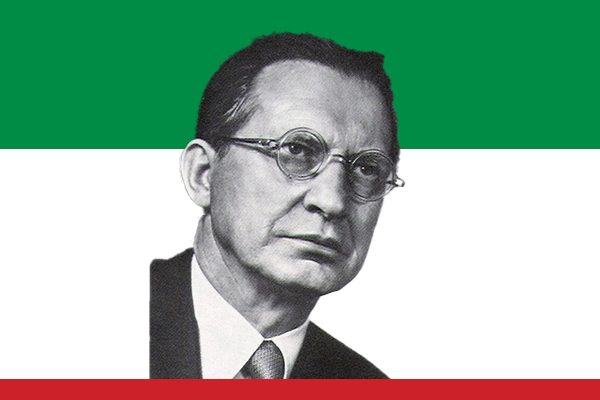
Early Life and Political Foundations
De Gasperi grew up in the Austro-Hungarian Empire and studied literature and philosophy at the University of Vienna. Early in life, he developed a deep belief in Christian democratic principles. In 1911, he joined the Italian People’s Party (Partito Popolare Italiano) and actively promoted democracy, social justice, and Catholic values. His early political engagement helped him establish a strong foundation as a reform-oriented leader.
During the Fascist regime, De Gasperi refused to support Benito Mussolini’s dictatorship. He actively opposed totalitarianism and defended democratic ideals, which led to his imprisonment. Despite these challenges, he maintained his political integrity and faith in democracy.
Leadership in Post-War Italy
After World War II, De Gasperi emerged as a unifying figure in Italian politics. He founded the Christian Democracy Party (Democrazia Cristiana) and actively led Italy through one of its most critical transitions. In 1945, he became Prime Minister and began rebuilding the nation’s devastated economy and institutions. De Gasperi’s administration actively restored democratic governance, reestablished civil rights, and revived Italy’s economy through modernization and industrial growth.
Economic Recovery and Social Reforms
As Prime Minister, De Gasperi implemented vital economic reforms that laid the groundwork for Italy’s “economic miracle.” He actively worked with the United States and Western allies to secure Marshall Plan aid, which revitalized the Italian economy. Under his leadership, the government invested in infrastructure, agriculture, and industry. He also introduced social welfare measures to support workers and families, helping Italy stabilize and prosper.
De Gasperi emphasized balanced development and promoted policies that benefited both northern industrial centers and southern agricultural regions. His practical economic vision ensured long-term sustainability and equity across Italy.
Strengthening Democracy and Foreign Relations
De Gasperi actively strengthened democratic institutions in post-war Italy. He advocated for a new constitution that protected fundamental rights and upheld parliamentary democracy. His political leadership stabilized Italy’s fragile democracy during a time of social unrest and political polarization.
On the international front, De Gasperi strongly aligned Italy with Western democracies. He played a central role in securing Italy’s membership in the North Atlantic Treaty Organization (NATO) and the Council of Europe. He also became one of the founding fathers of European integration, working alongside leaders like Robert Schuman and Konrad Adenauer to establish the foundations of what would become the European Union.
Legacy and Influence
Alcide De Gasperi left an enduring mark on both Italy and Europe. His leadership transformed Italy from a war-torn nation into a democratic, economically stable state. He actively promoted peace, cooperation, and unity across Europe. De Gasperi’s efforts to balance religious values with democratic governance inspired generations of Christian democratic leaders.
Even after his death in 1954, his vision continued to influence Italian and European politics. Today, historians remember him as a statesman of integrity, moderation, and foresight—a leader who believed that moral principles and pragmatic politics could coexist for the public good.
Conclusion
Prime Minister Alcide De Gasperi’s legacy shines as a testament to visionary leadership in times of crisis. He actively rebuilt Italy’s democratic institutions, restored its economy, and strengthened its global standing. Through dedication and foresight, he not only transformed Italy but also helped lay the foundation for a united Europe. His life’s work remains a powerful example of how commitment, faith, and political wisdom can reshape a nation’s destiny.