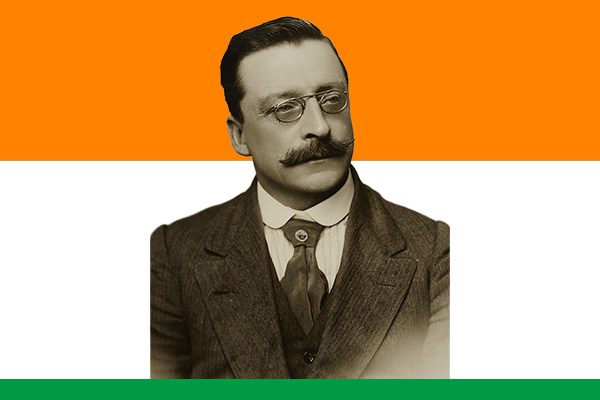
Early Life and Education
Arthur Griffith was born on March 31, 1871, in Dublin. He grew up in a middle-class family and received his education in local schools. As a young man, he developed a strong interest in Irish culture, history, and politics. He worked as a printer and journalist, which allowed him to express his views on Irish nationalism.
Griffith spent some time in Johannesburg, where he gained valuable experience and broadened his political understanding. After returning to Ireland, he became actively involved in nationalist movements and journalism.
Political Career
Arthur Griffith founded the political organization Sinn Féin in 1905. The name “Sinn Féin” means “Ourselves” or “We Ourselves.” He believed that Ireland should govern itself and achieve independence through peaceful political action rather than violence.
Griffith promoted the idea that Irish representatives should refuse to sit in the British Parliament and instead establish their own Irish assembly. This policy later became a central principle of Irish nationalism. His writings and speeches encouraged people to support self-government and preserve Irish culture.
Although Griffith was not directly involved in planning the 1916 Easter Rising, the British authorities mistakenly associated Sinn Féin with the rebellion. As a result, he was arrested and imprisoned. After his release, he continued his political work and gained greater public support.
Role in Irish Independence
The years following the Easter Rising saw Griffith emerge as a leading figure in Irish politics. In the 1918 general election, Sinn Féin won a large majority of Irish seats. Instead of taking their seats in the British Parliament, elected members formed the Irish parliament known as Dáil Éireann.
Griffith played a major role in promoting Irish independence on the international stage. During the Irish War of Independence, he worked closely with other nationalist leaders to secure recognition for Ireland’s cause.
One of his most significant achievements came in 1921 when he helped negotiate the Anglo-Irish Treaty. The treaty led to the creation of the Irish Free State, giving Ireland substantial self-government. Although the treaty was controversial and caused political divisions, Griffith believed it was an important step toward full independence.
Later Years and Death
After the treaty was signed, Arthur Griffith became President of Dáil Éireann. He worked hard to implement the agreement and establish the new Irish government. However, the political tensions surrounding the treaty placed enormous pressure on him.
On August 12, 1922, Arthur Griffith died suddenly in Dublin at the age of 51. His death was a great loss to Ireland during a critical period in its history. Many people remembered him as a dedicated patriot and a skilled political leader.
Legacy
Arthur Griffith’s contribution to Irish independence remains highly significant. As the founder of Sinn Féin and a key negotiator of the Anglo-Irish Treaty, he helped lay the foundation for modern Ireland. His commitment to self-government, national identity, and peaceful political action influenced generations of Irish leaders.
Today, Arthur Griffith is remembered as one of the architects of Irish independence. His vision and determination played a vital role in Ireland’s journey toward freedom and self-rule.
Conclusion
Arthur Griffith was a remarkable nationalist leader whose efforts transformed Irish politics. Through journalism, political leadership, and treaty negotiations, he advanced the cause of Irish independence. His achievements continue to be recognized and respected, making him an important figure in the history of Ireland.