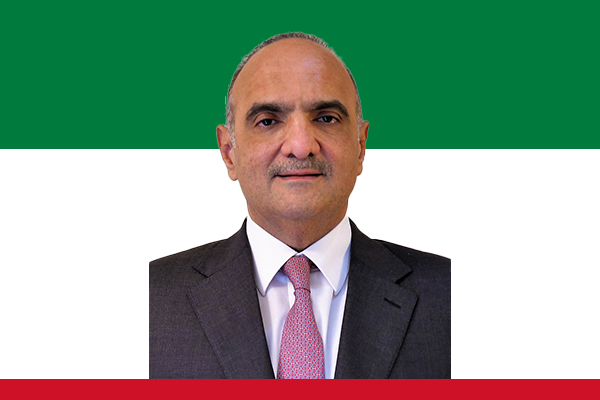
Early Life and Education
Born in Amman, Jordan, Khasawneh’s educational background reflects a strong foundation in law and international relations. He earned a Bachelor of Law (LLB) from the University of Jordan, followed by advanced legal studies at the London School of Economics and Political Science where he obtained both an LLM and a PhD in law. Additionally, he holds a Master’s degree in International Relations, Diplomacy and Economics from the School of Oriental and African Studies (SOAS), University of London.
Diplomatic and Government Career
Before becoming prime minister, Khasawneh had a distinguished diplomatic career. He served as Jordan’s ambassador to key countries and organizations, including Egypt, France, Kenya, Ethiopia, the African Union, the League of Arab States, and UNESCO. These ambassadorial roles showcased his expertise in international diplomacy and Jordan’s foreign policy interests.
Within the Jordanian government, his roles were diverse. Khasawneh served as Minister of State for Foreign Affairs (2016–2017) and Minister of State for Legal Affairs (2017–2018). He later became an adviser to King Abdullah II—first for Communication and Coordination and then for Policies—demonstrating his close involvement in shaping national strategy prior to his premiership.
Appointment as Prime Minister
Khasawneh was appointed prime minister during a particularly challenging period marked by the global COVID‑19 pandemic and its economic fallout. King Abdullah II tasked him with managing public health concerns while stabilizing the economy and preparing for parliamentary elections. His appointment was intended to bring experienced leadership to both domestic governance and Jordan’s international engagements.
Leadership and Policies
During his tenure, Khasawneh emphasized economic reform, security, and regional stability. Jordan’s economy, heavily reliant on tourism and foreign aid, faced headwinds due to pandemic impacts and geopolitical tensions in the Middle East. His government pursued measures to attract foreign investment, support small businesses, and manage budgetary pressures.
On foreign policy, Khasawneh often spoke about the risks of regional escalation. In April 2024, he stated that any intensification of conflict in the Middle East risked leading to “dangerous paths” and called for restraint by all parties to safeguard Jordan’s security.
He also dealt with delicate diplomatic positioning, including balancing Jordan’s relations with neighboring countries amid broader regional tensions. For instance, he publicly commented on national security considerations involving Iran, though official stances varied at times within Jordan’s leadership.
Government Resignation and Legacy
Following the parliamentary elections in September 2024—which were marked by gains for the opposition Islamic Action Front—Khasawneh’s government submitted its resignation to King Abdullah II as dictated by the Jordanian constitution. His tenure ended after nearly four years, with Jafar Hassan, a technocrat and former planning minister, designated to form the next government. Though customary after elections, his resignation also reflected shifts in political dynamics and public frustration over economic issues and regional policy choices.
Throughout his time in office, Khasawneh’s legacy has been one of steady managerial leadership during times of crisis. He brought diplomatic experience to domestic governance and sought to navigate Jordan through health, economic, and geopolitical challenges. His long service and multifaceted career underscore his role as a central figure in Jordan’s recent political history.
Post‑Premiership
After leaving office, Khasawneh remains a respected voice in Jordanian public life, with continued involvement in national affairs and contributions to policy discussions, leveraging his extensive experience in law, diplomacy, and governance.