Mr. Harold Macmillan
In Office: 10 January 1957 – 18 October 1963
Political Party: Conservative
Home State: Rushyford
Lifespan: 1894–1986
Country: United Kingdom
Image credits available here.
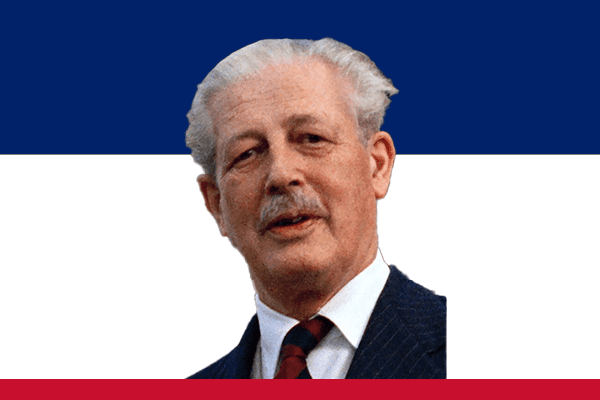
Early Life and Political Career
Harold Macmillan was born on 10 February 1894 in Chelsea, London, England. He studied at Eton College and later attended Balliol College, Oxford. However, the First World War interrupted his education. He served bravely in the British Army and suffered serious injuries during the war. His wartime experiences shaped his character and political views.
Macmillan entered politics as a member of the Conservative Party. He became Member of Parliament (MP) for Stockton-on-Tees in 1924. Although he lost his seat for a time, he returned to Parliament in 1931. Over the years, he built a reputation as a thoughtful and capable politician. During the Second World War, he held several government roles and gained valuable administrative experience.
Rise to Prime Minister
Harold Macmillan rose steadily through the ranks of British politics. He served in important cabinet positions, including Minister of Housing, Minister of Defence, Foreign Secretary, and Chancellor of the Exchequer. In 1957, after Anthony Eden resigned following the Suez Crisis, Macmillan became Prime Minister of the United Kingdom.
His appointment came during a difficult period for Britain. The country faced international embarrassment after the Suez Crisis, and public confidence in the government had weakened. Macmillan quickly restored stability and brought renewed energy to the Conservative Party.
Leadership and Achievements
As Prime Minister, Harold Macmillan focused on economic prosperity, national unity, and Britain’s place in the world. Under his leadership, Britain experienced a period of rising employment, higher wages, and improved living standards. Many families bought homes, televisions, and cars for the first time. This prosperity helped the Conservatives win the 1959 general election with a strong majority.
Macmillan also worked to modernize housing and infrastructure. He supported large-scale home construction and encouraged social development. His government recognized the importance of adapting to changing public expectations in post-war Britain.
In foreign policy, Macmillan played a key role during the Cold War. He maintained close relations with the United States and helped improve Anglo-American ties after the damage caused by the Suez Crisis. He also supported nuclear cooperation and diplomacy between East and West.
One of his most important contributions was his role in the decolonization of Africa. In 1960, during a speech in South Africa, he delivered the famous “Wind of Change” speech. In it, he acknowledged that African nationalism was growing rapidly and that Britain needed to accept political change across the continent. This speech became a symbol of the end of the British Empire in Africa.
Challenges and Resignation
Despite his successes, Macmillan’s later years in office brought serious difficulties. His government faced criticism over economic problems, defence issues, and political scandals. The most damaging was the Profumo Affair in 1963, which weakened public trust in the Conservative government.
At the same time, Britain’s attempt to join the European Economic Community (EEC) failed when French President Charles de Gaulle vetoed the application in 1963. This setback damaged Macmillan’s European policy.
In October 1963, Harold Macmillan resigned as Prime Minister due to ill health. His resignation marked the end of an important chapter in British politics.
Legacy
Harold Macmillan left behind a significant legacy as a skilled statesman and reform-minded Conservative leader. He guided Britain through prosperity, decolonization, and Cold War diplomacy. Historians often remember him as a leader who balanced tradition with change. His premiership remains an important part of twentieth-century British political history.