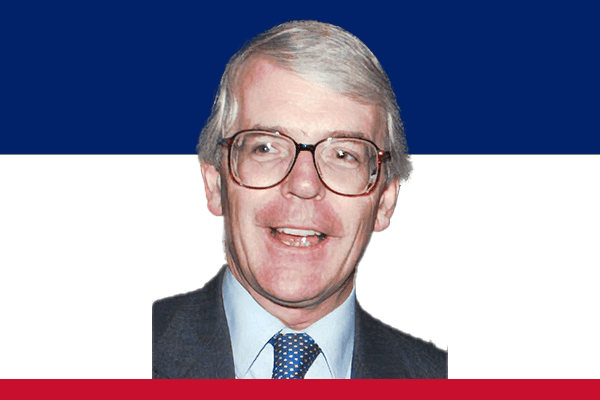
Mr. John Major
In Office: 28 November 1990 – 2 May 1997
Political Party: Conservative
Home State: Grantham
Lifespan: born 1943
Country: United Kingdom
Image credits available here.
Early Political Rise
John Major began his political career in local government and gradually built a reputation as a capable and pragmatic politician. He won election as a Member of Parliament in 1979 and quickly rose through the ranks of the Conservative Party. Major served in several important government positions, including Chief Secretary to the Treasury and Foreign Secretary. In 1989 he became Chancellor of the Exchequer under Prime Minister Margaret Thatcher.
His calm personality, practical approach, and ability to work with colleagues earned him respect within the party. When internal party tensions forced Margaret Thatcher to resign in 1990, the Conservative Party elected Major as its new leader. As a result, he became Prime Minister of the United Kingdom in November 1990.
Premiership and the 1992 Election
John Major inherited a government that faced economic recession and growing political divisions. Many observers expected the Conservative Party to lose the next general election. However, Major led an energetic national campaign and successfully connected with voters.
In the 1992 general election, he secured a surprising victory for the Conservatives, defeating the opposition led by Neil Kinnock of the Labour Party. This victory strengthened Major’s authority and allowed him to continue implementing his political agenda.
Economic Challenges
Major’s government faced serious economic difficulties during the early 1990s. Britain experienced high unemployment, slow economic growth, and financial instability. One of the most dramatic events occurred in 1992 during the crisis known as Black Wednesday.
On that day, Britain withdrew from the European Exchange Rate Mechanism after intense pressure on the British pound. The crisis damaged the government’s reputation for economic competence and became one of the most controversial moments of Major’s leadership.
Despite this setback, the British economy eventually began to recover in the mid-1990s, with falling inflation and improving growth.
Northern Ireland Peace Process
One of the most significant achievements of John Major’s premiership was his role in advancing the peace process in Northern Ireland. For decades, the region had suffered from violence and political conflict known as The Troubles.
Major’s government opened secret negotiations with various political groups and encouraged dialogue between opposing sides. His efforts helped create conditions that later led to the Good Friday Agreement. Although this agreement was signed after his premiership ended, Major’s initiatives played an important role in building the foundation for peace.
European Policy and Party Divisions
European integration became one of the most controversial issues during Major’s time in office. His government signed the Maastricht Treaty, which helped establish the European Union.
However, the treaty created deep divisions within the Conservative Party. Some members strongly supported closer European cooperation, while others opposed it. Major struggled to maintain party unity as parliamentary debates and rebellions repeatedly challenged his authority.
End of Premiership and Legacy
By the mid-1990s, political scandals, internal party conflicts, and public dissatisfaction weakened the Conservative government. In the 1997 general election, the Conservatives suffered a major defeat against the Labour Party led by Tony Blair.
After leaving office, John Major remained active in public life and continued to contribute to political discussions. Many historians view his leadership as steady and pragmatic, especially during difficult circumstances.
Conclusion
John Major led the United Kingdom during a challenging period marked by economic problems, political divisions, and debates over Europe. Despite these obstacles, he achieved important successes, including an unexpected electoral victory and progress in the Northern Ireland peace process. His premiership remains an important chapter in modern British political history.