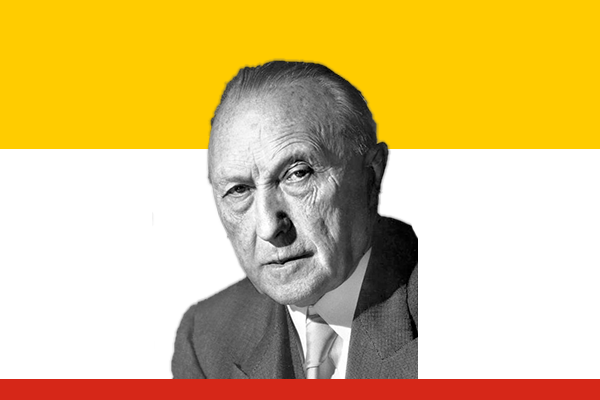
Early Life and Education
Konrad Adenauer was born on January 5, 1876, in Cologne, Germany. He studied law and political science at the universities of Freiburg, Munich, and Bonn. After completing his studies, he worked as a lawyer and later entered local politics. His early experiences in public service shaped his pragmatic approach to governance and his commitment to democratic institutions.
Political Career Before World War II
Adenauer became the Mayor of Cologne in 1917 and held the position until 1933. During his tenure, he implemented infrastructure improvements, modernized the city’s administration, and promoted social welfare programs. He opposed the Nazi regime and was briefly imprisoned in 1933 for his political stance. These experiences strengthened his dedication to democratic governance and human rights.
Rise to National Leadership
After World War II, Adenauer played a key role in founding the Christian Democratic Union (CDU), which sought to unite conservative and centrist forces in post-war Germany. In 1949, the Bundestag elected him as Germany’s first Chancellor. Adenauer faced the enormous challenge of rebuilding a country devastated by war while navigating the emerging Cold War tensions.
Domestic Policies and Economic Recovery
Adenauer implemented policies that promoted economic recovery and political stability. He supported the Marshall Plan, which injected U.S. funds into West Germany, helping to revive industry and infrastructure. He also introduced the social market economy, blending free-market capitalism with social welfare programs. Under his leadership, West Germany experienced rapid economic growth, known as the “Wirtschaftswunder” or economic miracle.
Foreign Policy and Diplomacy
Adenauer prioritized West Germany’s integration into the Western political and security framework. He fostered strong relations with the United States and other Western allies while negotiating West Germany’s entry into NATO in 1955. He also pursued reconciliation with France, signing the Élysée Treaty in 1963, which cemented a foundation for lasting Franco-German cooperation. Adenauer emphasized diplomacy, firmly anchoring West Germany in the Western alliance.
Social and Political Reforms
Adenauer promoted democratic institutions and sought to heal divisions caused by war. He encouraged political pluralism, supported federalism, and reinforced the rule of law. Adenauer also advocated for education reforms, reconstruction of cities, and the promotion of civic engagement, helping Germans rebuild trust in democracy.
Legacy and Impact
Konrad Adenauer retired in 1963 but left a lasting legacy on Germany and Europe. He strengthened democratic governance, rebuilt the economy, and established Germany as a respected international actor. Leaders and historians remember him for his pragmatic leadership, diplomatic skill, and commitment to social and political stability. His vision shaped modern Germany’s political and economic trajectory.
Conclusion
Konrad Adenauer transformed post-war Germany into a democratic, economically strong, and internationally respected nation. His leadership bridged the horrors of the past and the promise of a stable, prosperous future. Through his policies, diplomacy, and reforms, Adenauer left an enduring mark on Germany and the broader European landscape.