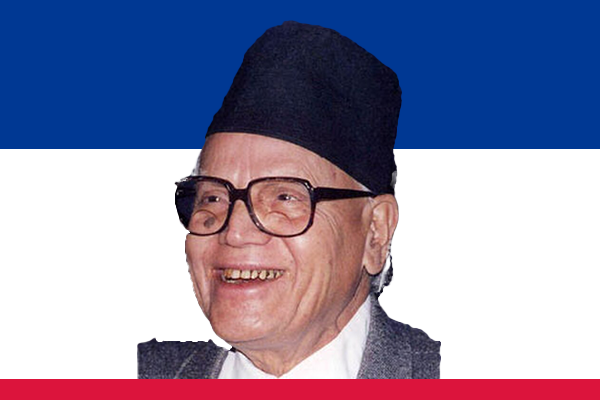
Mr. Krishna Prasad Bhattarai
In Office: 31 May 1999 – 22 March 2000
Term 2: 19 April 1990 – 26 May 1991
Political party: Nepali Congress
Home State: Varanasi
Lifespan: 1924–2011
Image(A-12) credit available here.
Early Life and Education
Krishna Prasad Bhattarai was born on December 13, 1924, in Varanasi, India, to a Nepali Brahmin family. He grew up in a simple household that valued education and culture. He studied economics and political science at Banaras Hindu University. His student years exposed him to democratic ideals, which influenced his lifelong political journey.
Role in Democratic Movement
Bhattarai actively joined the fight against the Rana regime that had ruled Nepal for over a century. He became a founding member of the Nepali Congress Party. His commitment to democracy and freedom inspired many young activists. He organized protests, mobilized students, and raised public awareness against authoritarian rule. His leadership gave strength to the democratic movement.
Contribution in 1951 Revolution
When the 1951 revolution overthrew the Rana rule, Bhattarai worked tirelessly to establish democratic governance. He served as a key leader in shaping Nepal’s new political structure. His speeches and writings promoted freedom of speech, equality, and justice. He encouraged ordinary citizens to participate in building a democratic society.
Leadership during the 1990 People’s Movement
Bhattarai’s most significant role came during the 1990 People’s Movement. He led the Nepali Congress in a nationwide campaign against the Panchayat system, which denied political freedom. Millions of Nepalis joined the movement under his guidance. The success of this uprising restored multiparty democracy in Nepal. His calm leadership and negotiation skills prevented bloodshed and united diverse groups.
Tenure as Prime Minister
Krishna Prasad Bhattarai became Nepal’s Prime Minister twice. His first term came in 1990 after the success of the movement, when he led the interim government. He drafted a new constitution and organized Nepal’s first free elections in decades. His second term began in 1999, when he worked to strengthen democratic institutions and improve Nepal’s economy. He emphasized transparency, honesty, and simple living in politics.
Legacy and Death
Bhattarai lived a humble life, free from corruption and personal gain. Nepalis admired him for his integrity and clean politics. He passed away on March 4, 2011, in Kathmandu, at the age of 87. His legacy as a democratic leader remains an inspiration for generations.
Conclusion
Krishna Prasad Bhattarai led Nepal through crucial political changes with wisdom and honesty. His dedication to democracy, simplicity, and service to the people made him one of Nepal’s most respected leaders.