Mr. Charles W. Fairbanks
In Office: March 4, 1905 – March 4, 1909
Political Party: Republican
Home State: Ohio
Lifespan: 1852–1918
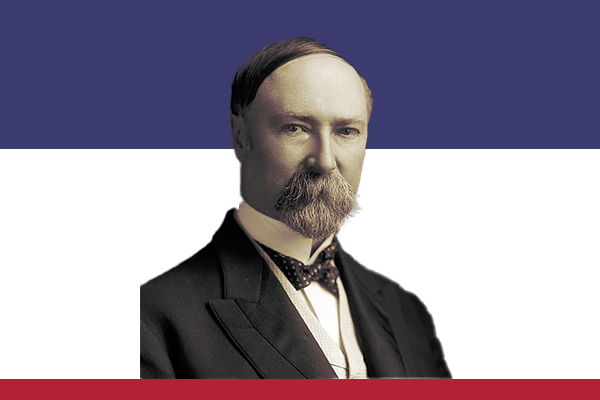
Charles Warren Fairbanks (1852–1918) was an American politician, lawyer, and statesman who served as the 26th Vice President of the United States under President Theodore Roosevelt from 1905 to 1909. A prominent figure in the conservative wing of the Republican Party, Fairbanks was known for his reserved demeanor and steady support of traditional Republican principles during a period of major political and social change in the U.S.
Early Life and Education
Charles W. Fairbanks was born on May 11, 1852, in a log cabin near Unionville Center, Ohio. He grew up in a modest, hardworking farming family and rose from humble beginnings through education and determination. He graduated from Ohio Wesleyan University in 1872 and soon moved to Indianapolis, Indiana, where he studied law and entered the legal profession. Fairbanks quickly became successful as a railroad attorney and corporate lawyer, gaining influence and wealth.
Entry into Politics
Fairbanks became active in Republican politics in Indiana, which was a key battleground state at the time. He gained national attention during the 1888 presidential campaign by supporting Benjamin Harrison, also an Indiana native. Although he initially failed in his first bid for the U.S. Senate in 1893, he remained politically active and built a strong Republican network in the Midwest.
He was elected to the U.S. Senate in 1896 and served from 1897 to 1905. In the Senate, Fairbanks aligned with the conservative, pro-business wing of the Republican Party. He supported the gold standard, protective tariffs, and limited government regulation—positions that sometimes put him at odds with the growing progressive movement, which was gaining momentum within the party.
Vice Presidency (1905–1909)
In 1904, President Theodore Roosevelt selected Fairbanks as his running mate after Roosevelt, who had succeeded the assassinated President William McKinley in 1901, sought election in his own right. The Roosevelt-Fairbanks ticket won a decisive victory.
Fairbanks, however, had little influence on Roosevelt’s policies. Roosevelt was a dynamic and reform-minded leader who pushed a bold Progressive agenda, including trust-busting, railroad regulation, and conservation efforts. Fairbanks, by contrast, was a conservative who preferred limited government intervention and held more traditional Republican views. As Vice President, he presided over the Senate but was largely sidelined from executive decision-making. While respected for his decorum and legislative knowledge, he did not play an active role in shaping national policy.
Later Political Career
After leaving office in 1909, Fairbanks remained a major figure in the Republican Party. He unsuccessfully sought the Republican presidential nomination in 1908, losing to William Howard Taft. In 1912, when the Republican Party split between the conservative Taft faction and the Progressive Roosevelt faction (who ran as a third-party candidate), Fairbanks stayed loyal to Taft.
Fairbanks attempted a political comeback in 1916 when he was nominated as the Republican vice-presidential candidate on a ticket with former Supreme Court Justice Charles Evans Hughes. The Hughes-Fairbanks ticket narrowly lost to the Democratic incumbents, President Woodrow Wilson and Vice President Thomas R. Marshall.
Death and Legacy
Charles W. Fairbanks died on June 4, 1918, in Indianapolis at the age of 66. Though not known for charisma or sweeping reforms, Fairbanks was respected for his integrity, legal mind, and loyalty to conservative Republican ideals. His career reflected the tensions within the Republican Party during a time of transformation, as Progressivism began to reshape American politics.
The city of Fairbanks, Alaska, was named in his honor in 1901, recognizing his support for territorial development. Though he played a relatively quiet role as Vice President, Fairbanks remains a representative figure of the Gilded Age and early 20th-century conservatism in American political life.