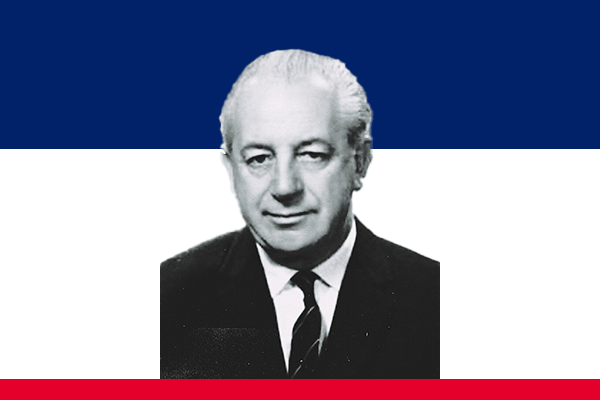
Early Life and Education
Harold Edward Holt was born on August 5, 1908, in Sydney, Australia. He grew up in Melbourne after his parents separated, and he attended Wesley College. He studied law at the University of Melbourne, where he demonstrated strong leadership qualities and developed an interest in politics. Holt actively participated in student debates, which prepared him for his future role in national leadership.
Entry into Politics
Holt entered federal politics in 1935 when he won the by-election for the House of Representatives seat of Fawkner in Victoria. He joined the United Australia Party, which later merged into the Liberal Party of Australia. Holt built his reputation as a diligent and persuasive parliamentarian, and his career quickly advanced. His early ministerial roles included serving as Minister for Labour and National Service, where he focused on industrial relations and employment issues.
Rise in the Liberal Party
As Robert Menzies established the Liberal Party’s dominance in Australian politics, Holt became a trusted deputy. He handled several important portfolios, including Immigration, where he helped shape Australia’s post-war migration program. Holt supported policies that welcomed thousands of European migrants, transforming the cultural and social landscape of Australia. His dedication to party unity and administrative efficiency earned him recognition as a reliable leader within the Liberal Party.
Prime Ministership
When Robert Menzies retired in January 1966, Harold Holt succeeded him as the 17th Prime Minister of Australia. Holt entered office with widespread support from his party and the public. He projected a modern and energetic style of leadership that contrasted with Menzies’ long, traditional approach.
Holt led the Liberal–Country coalition to a historic electoral victory in 1966. His campaign emphasized strong defense, economic stability, and commitment to international alliances. Australians admired his approachable and charismatic personality, which helped him connect with citizens.
Domestic Policies and Reforms
Holt promoted significant domestic reforms during his time as Prime Minister. His government advanced social and legal changes that moved Australia toward a more progressive society. He championed the landmark 1967 referendum, which allowed the federal government to make laws for Aboriginal Australians and include them in the national census. The referendum passed overwhelmingly, marking a historic moment for Indigenous rights.
He also liberalized economic policies by supporting greater trade opportunities and encouraging investment. Holt strengthened Australia’s financial systems while continuing to expand immigration programs that fueled economic growth and diversity.
Foreign Policy and Vietnam War
Holt placed great importance on foreign policy, especially Australia’s alliance with the United States. He strongly supported America’s involvement in the Vietnam War, famously declaring that Australia would go “all the way with LBJ,” referring to U.S. President Lyndon B. Johnson. This alignment reinforced Australia’s role as a key partner of the United States in the Asia-Pacific region.
However, his stance on Vietnam generated criticism at home. Anti-war protests grew as Australians questioned the government’s commitment to the conflict. Despite this, Holt maintained that the war was essential to containing communism and protecting regional security.
Tragic Disappearance
On December 17, 1967, Harold Holt disappeared while swimming at Cheviot Beach near Portsea, Victoria. Despite extensive search efforts, his body was never recovered. His sudden and mysterious disappearance shocked the nation and the world. Rumors and conspiracy theories circulated, but the official explanation concluded that Holt drowned due to dangerous surf conditions.
Legacy
Harold Holt’s prime ministership, though brief, left a lasting impact on Australia. He guided the nation through social change, strengthened alliances, and supported Indigenous rights. His disappearance remains one of the most remarkable and tragic events in Australian political history. Holt is remembered both for his reforms and for the mystery that ended his leadership.