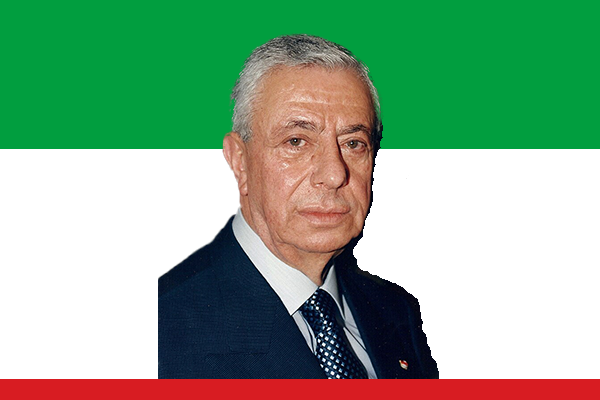
President Elias Hrawi
Elias Hrawi served as the President of Lebanon from 1989 to 1998, a critical period in the country’s history marked by the end of the Lebanese Civil War and the beginning of national reconstruction. Born on September 4, 1926, in Zahle, in the Beqaa Valley, Hrawi came from a prominent political family. He pursued his early education in Lebanon and later became involved in agriculture and business before entering politics. His political career formally began when he was elected to the Lebanese Parliament in 1972, representing Zahle. Over time, he gained a reputation as a pragmatic and moderate leader.
Hrawi assumed the presidency on November 24, 1989, following the assassination of President René Moawad. His election came at a decisive moment when Lebanon was deeply divided by years of civil conflict that had begun in 1975. The Taif Agreement, signed in October 1989 in Saudi Arabia, provided the framework for ending the civil war and restructuring Lebanon’s political system. Hrawi strongly supported the Taif Agreement and played a central role in implementing its provisions.
The Taif Agreement brought significant constitutional reforms. It rebalanced power between Lebanon’s religious communities, reducing the authority of the Maronite Christian president and increasing the powers of the Sunni Muslim prime minister and the cabinet. It also called for the disbanding of militias and the extension of state authority across the country. During Hrawi’s presidency, many militias were dissolved, and efforts were made to unify the Lebanese Armed Forces under central command. These steps were crucial in restoring a degree of stability after fifteen years of violence.
One of the defining aspects of Hrawi’s presidency was Lebanon’s close relationship with Syria. Syrian forces had been present in Lebanon since 1976, and their influence grew stronger after the Taif Agreement. Hrawi maintained a cooperative relationship with the Syrian leadership, particularly President Hafez al-Assad. In 1991, Lebanon and Syria signed a Treaty of Brotherhood, Cooperation, and Coordination, formalizing ties between the two countries. Critics argued that Syrian influence undermined Lebanon’s sovereignty, while supporters contended that Syrian support was necessary for maintaining stability during the fragile post-war years.
Hrawi also focused on reconstruction and economic recovery. After years of destruction, Lebanon faced immense challenges in rebuilding infrastructure, restoring public services, and reviving the economy. His administration worked alongside Prime Minister Rafik Hariri, who became a key figure in reconstruction efforts. Major projects aimed to rebuild Beirut’s central district and modernize infrastructure. Although progress was made, economic difficulties persisted, including rising public debt and uneven development.
In 1995, Lebanon’s Parliament amended the constitution to extend Hrawi’s presidential term by three years, allowing him to remain in office until 1998. This decision was controversial, as critics viewed it as influenced by Syrian interests and a departure from democratic norms. Nevertheless, Hrawi continued to oversee the consolidation of state institutions and the implementation of post-war reforms.
By the end of his presidency in 1998, Lebanon had achieved relative stability compared to the height of the civil war. While political tensions and external influences remained, Hrawi’s tenure marked the transition from conflict to reconstruction. He was succeeded by President Émile Lahoud.
Elias Hrawi passed away on July 7, 2006. His legacy remains closely tied to the Taif Agreement and the complex process of rebuilding Lebanon after one of the most devastating conflicts in its history. Supporters credit him with helping to end the civil war and restore state authority, while critics question the extent of Syrian influence during his presidency. Regardless of differing perspectives, Hrawi played a significant role in shaping Lebanon’s post-war political landscape.