BAHRAIN
Bahrain Flag
The national flag of Bahrain features a bold red field on the right and a white vertical band on the left, separated by a zigzag line with five white triangles. The five points represent the Five Pillars of Islam. Red traditionally symbolizes bravery and the country’s historical ties to the Kharijite sect, while white stands for peace. The current design was officially adopted in 2002 and reflects Bahrain’s Islamic heritage and national identity.
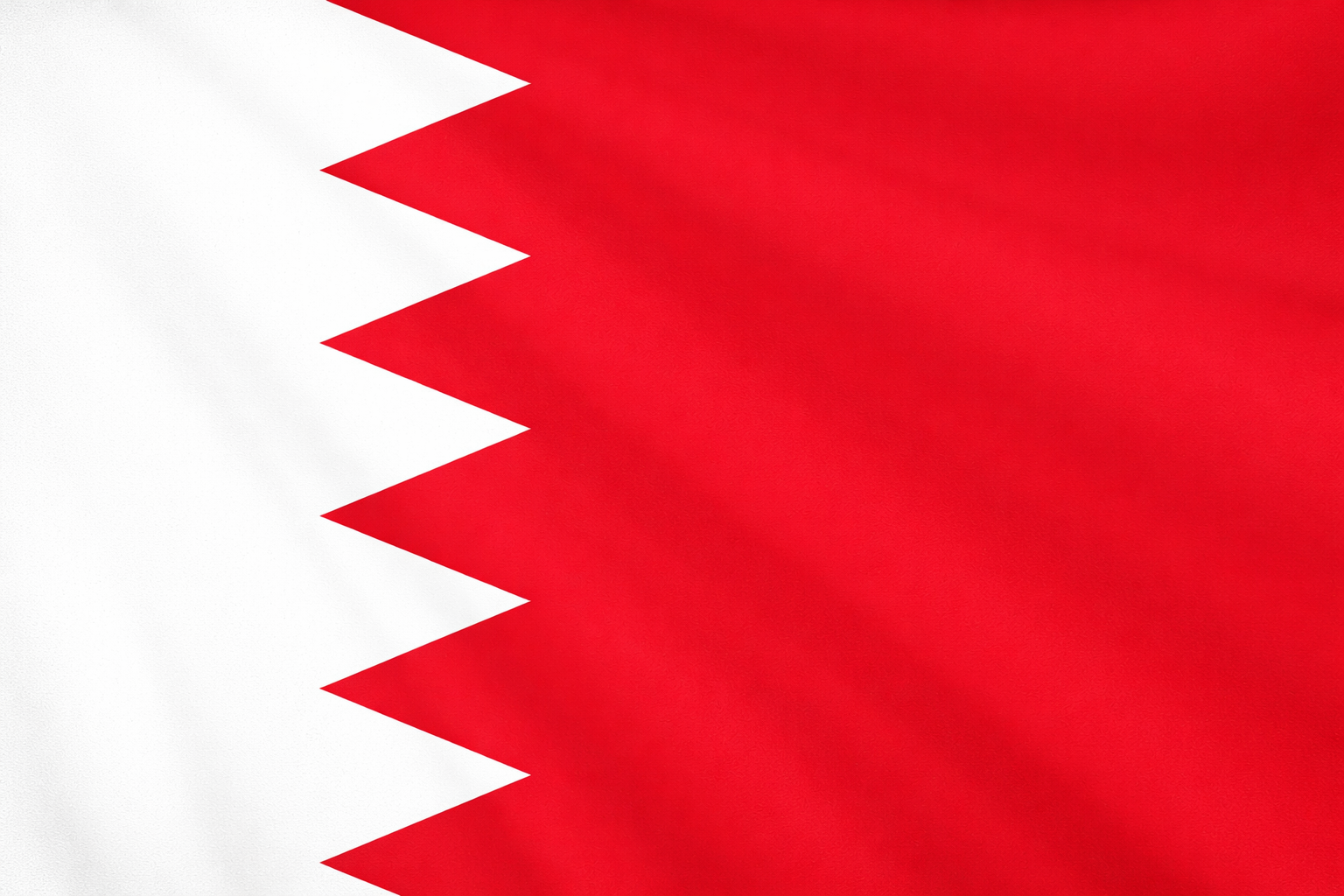
Bahrain
Bahrain is a small island country located in the Persian Gulf in the Middle East. It lies between Saudi Arabia to the west and Qatar to the southeast. The capital city is Manama, which serves as the political, cultural, and economic center of the country. Despite its small size, Bahrain has played an important role in regional trade and history for thousands of years.
Bahrain consists of more than 30 natural and artificial islands, with Bahrain Island being the largest. The country has a desert climate, characterized by very hot summers and mild winters. Because of limited rainfall and natural freshwater resources, agriculture is restricted. However, date palms, vegetables, and some fruits are grown using irrigation. The surrounding waters provide fish and seafood, which are important parts of the local diet.
Historically, Bahrain was home to the ancient Dilmun civilization, which was an important trading hub between Mesopotamia and the Indus Valley. In the 19th century, Bahrain became a British protectorate. It gained full independence in 1971. Since then, Bahrain has developed rapidly, especially in finance and tourism.
The official religion of is Islam, and the majority of the population follows either Sunni or Shia Islam. Arabic is the official language, though English is widely spoken in business and education. The country is ruled by the Al Khalifa family, and it functions as a constitutional monarchy.
Bahrain’s economy was once heavily dependent on oil production. It was one of the first Gulf countries to discover oil in 1932. However, oil reserves are smaller compared to its neighbors. As a result, Bahrain diversified its economy and became a major financial center in the Gulf region. Banking, aluminum production, construction, and tourism are key sectors today. The Bahrain International Circuit also hosts international motor racing events, including Formula One.
Education and healthcare systems in Bahrain are well developed compared to many countries in the region. The government provides free education to citizens, and literacy rates are high. The country has also invested in modern infrastructure, including bridges such as the King Fahd Causeway, which connects Bahrain to Saudi Arabia.
Culturally, Bahrain blends traditional Arab customs with modern influences. Traditional music, handicrafts, and festivals remain important, while shopping malls, international restaurants, and skyscrapers reflect modernization. The people of Bahrain are known for their hospitality and openness to different cultures.
In conclusion, is a small but influential Gulf nation with a rich history, a diversified economy, and a unique blend of tradition and modernity. Despite limited natural resources, it has successfully developed into an important financial and cultural hub in the Middle East.