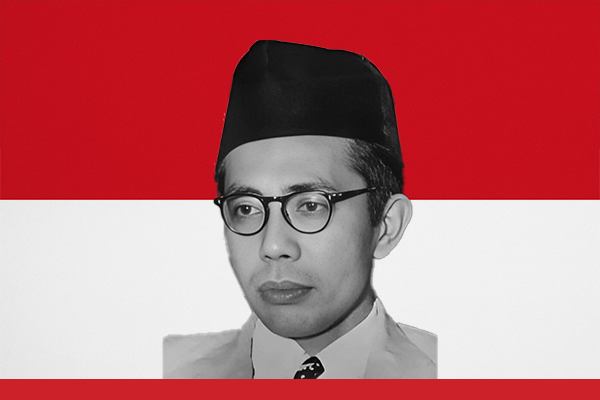
Mr. Mohammad Natsir
In Office: 6 September 1950 – 27 April 1951
Political Party: Masyumi Party
Home State: Solok Regency
Lifespan: 1908–1993
Country: Indonesia
Image credits available here.
Early Life and Education
Mohammad Natsir was born on July 17, 1908, in Alahan Panjang, West Sumatra, Indonesia. His family valued education and faith, which shaped his character from an early age. Natsir studied at Dutch colonial schools, where he gained knowledge of Western thought while maintaining his Islamic identity. He later attended the AMS (Algemene Middelbare School) in Bandung, one of the most prestigious institutions in the Dutch East Indies. His exposure to both modern and religious education encouraged him to blend nationalism with moral integrity.
Entry into Politics
Natsir began his political career through involvement in Islamic organizations. He joined the Jong Islamieten Bond (Young Muslim Association), where he promoted Islamic awareness among young Indonesians. In 1938, he established the Persatuan Islam (PERSIS) educational network, which aimed to improve literacy and promote Islamic education. His leadership and oratory skills attracted the attention of national leaders fighting for Indonesia’s independence.
Role in Indonesia’s Independence
During the Japanese occupation (1942–1945), Natsir continued to support nationalist movements discreetly. After Indonesia declared independence in 1945, he joined the Masyumi Party (Majelis Syuro Muslimin Indonesia), which represented the political voice of Muslims. Natsir played an important role in shaping Indonesia’s political foundation by advocating democratic principles based on moral and religious values.
As Minister of Information
President Sukarno appointed Natsir as Minister of Information in the early years of independence. In this position, Natsir used his communication skills to unify the people and promote national awareness. He emphasized the importance of maintaining harmony between Indonesia’s diverse religious and ethnic groups. Through his ministry, he spread messages of unity and resilience during the difficult post-independence years.
Appointment as Prime Minister
In 1950, Mohammad Natsir became the first Prime Minister of the Republic of the United States of Indonesia after the country transitioned back to a unitary state. He submitted the “Natsir Motion”, which called for national unity by merging the federal states into a single republic. Parliament approved his proposal, and Natsir successfully led the unification process. His leadership strengthened Indonesia’s identity as one nation under one government.
Policies and Governance
As Prime Minister, Natsir prioritized national integration, education, and economic recovery. He encouraged the spread of education in rural areas and promoted Islamic schools as centers of moral and intellectual development. He also sought to stabilize the economy after years of colonial exploitation and war. Natsir worked to strengthen Indonesia’s foreign relations by building partnerships with Asian and Middle Eastern nations. He believed that Indonesia should play an independent role in world affairs while remaining true to its cultural and religious roots.
Challenges and Resignation
Despite his achievements, Natsir faced political challenges from various parties with differing ideologies. Conflicts between secular and Islamic political groups weakened his government’s stability. After only one year in office, he resigned in 1951, marking the end of his tenure as Prime Minister. However, he continued to serve the nation as a respected parliamentarian and Islamic intellectual.
Later Life and Contributions
After leaving office, Natsir focused on education, Islamic propagation, and writing. He became a leading figure in the Dewan Dakwah Islamiyah Indonesia (Indonesian Islamic Propagation Council), which he founded in 1967. He traveled across the country to promote Islamic education and moral development. Even under the restrictive rule of President Suharto, Natsir continued to advocate for democracy and human rights.
Legacy and Recognition
Mohammad Natsir left a lasting legacy as a statesman, educator, and reformer. He united Indonesia through his “Natsir Motion” and strengthened the role of Islam in the nation’s moral framework. His dedication to education and social justice inspired future generations of leaders. In 2008, the Indonesian government honored him as a National Hero for his contributions to the country’s unity and independence.
Conclusion
Prime Minister Mohammad Natsir shaped Indonesia’s political and moral foundations during a critical period in its history. His leadership combined intellect, faith, and patriotism. By promoting unity and education, he helped Indonesia emerge as a strong, independent nation guided by values of justice and integrity.