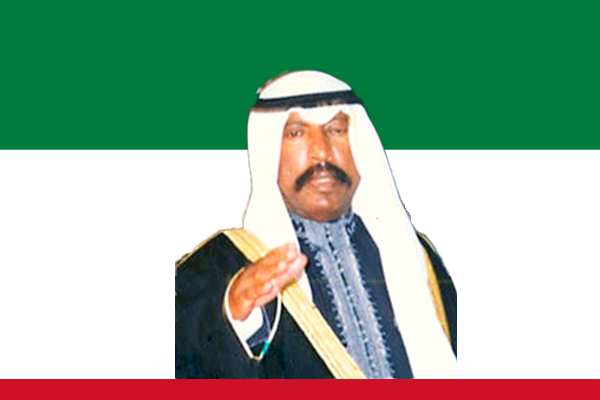
Saad Al-Abdullah Al-Salim Al-Sabah
Saad Al-Abdullah Al-Salim Al-Sabah was a prominent Kuwaiti statesman and a senior member of the ruling Al-Sabah family who played a decisive role in shaping Kuwait’s modern political and security institutions. Born on May 13, 1930, in Kuwait City, he was the eldest son of Emir Abdullah Al-Salim Al-Sabah, the ruler credited with guiding Kuwait toward independence in 1961 and establishing its constitution in 1962. Growing up in a politically influential household, Saad received his early education in Kuwait before pursuing police and security training in the United Kingdom, an experience that later influenced his approach to national security and governance.
Saad Al-Abdullah began his public service career in the early years of Kuwait’s state-building period. In 1961, the same year Kuwait gained independence from Britain, he was appointed as the first Minister of Interior. In this position, he focused on building modern police and security forces capable of maintaining internal stability. His tenure as Interior Minister was marked by institutional reforms and the establishment of professional standards within Kuwait’s law enforcement agencies. He later also served as Minister of Defense, further consolidating his reputation as a key architect of Kuwait’s security framework.
In 1978, Saad Al-Abdullah was appointed Prime Minister of Kuwait. As Prime Minister, he worked closely with the ruling Emir to oversee the country’s executive administration during a period characterized by economic growth driven by oil revenues, as well as regional instability. His leadership coincided with major geopolitical events in the Middle East, including the Iran-Iraq War (1980–1988), which posed security and economic challenges to Gulf states. During this time, he emphasized strengthening Kuwait’s defensive capabilities and maintaining diplomatic balance in a volatile region.
One of the most defining moments of his political career came during the Iraqi invasion of Kuwait in August 1990. When forces led by Iraqi President Saddam Hussein occupied Kuwait, the ruling family and government officials, including Saad Al-Abdullah, fled to Saudi Arabia. From exile, he played a crucial role in organizing international diplomatic efforts and coordinating with coalition forces to liberate Kuwait. After the country’s liberation in February 1991, he was instrumental in rebuilding state institutions and restoring normal governance.
In 2003, Saad Al-Abdullah was appointed Crown Prince, reflecting the trust placed in him by the ruling family and the political establishment. Three years later, in January 2006, following the death of Emir Jaber Al-Ahmad Al-Sabah, he briefly became Emir of Kuwait. However, due to serious health issues that had affected him for several years, he was unable to fulfill the constitutional oath before parliament. Consequently, he stepped down after only a few days, marking one of the shortest reigns in Kuwaiti history. He was succeeded by Sheikh Sabah Al-Ahmad Al-Sabah.
Saad Al-Abdullah Al-Salim Al-Sabah passed away on May 13, 2008. His legacy remains closely associated with the development of Kuwait’s internal security institutions and his steadfast role during the 1990–1991 Gulf crisis. Throughout his decades of public service, he was regarded as a firm and disciplined administrator who prioritized stability and national unity. His contributions during critical periods of Kuwait’s history continue to be acknowledged as foundational to the country’s modern governance structure.