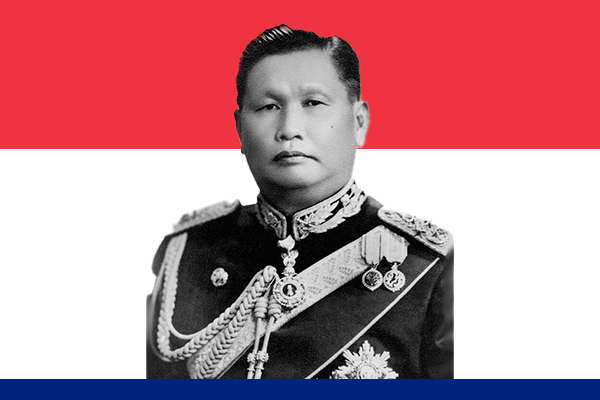
Early Life and Military Career
Sarit Thanarat was born on 16 June 1908 in Nakhon Phanom, Thailand. He grew up in a disciplined environment that encouraged respect for authority and national service. Sarit chose a military career early in life and enrolled in military education institutions, where he gained professional training and leadership skills.
During his early military service, Sarit built a reputation as a capable and ambitious officer. He steadily rose through the ranks of the Thai Army by demonstrating loyalty to senior commanders and the monarchy. His experiences during World War II and the post-war period strengthened his belief that strong military leadership was essential for national stability.
Rise to Political Power
Sarit entered national politics during a time of frequent coups and fragile civilian governments. He played a key role in the 1957 coup that removed Prime Minister Plaek Phibunsongkhram from power. After the coup, Sarit initially allowed a civilian government to function, but he retained significant influence behind the scenes.
In 1958, Sarit staged another coup, dissolved parliament, suspended the constitution, and assumed direct control of the government. In 1959, he formally became Prime Minister of Thailand. Through these actions, Sarit established himself as the most powerful figure in the country.
Governance and Political Style
As Prime Minister, Sarit Thanarat ruled in an authoritarian manner. He centralized power in the executive branch and governed largely by decree. Sarit banned political parties, restricted press freedom, and detained or silenced critics. He justified these measures by arguing that Thailand needed discipline and unity to prevent chaos and communist influence.
Sarit strongly promoted nationalism, traditional values, and obedience to authority. He openly supported the monarchy and restored its public prestige, presenting the king as a unifying symbol of the nation. This close relationship between the military government and the monarchy became a defining feature of Thai politics.
Economic and Social Reforms
Despite his authoritarian rule, Sarit prioritized economic development and modernization. He launched ambitious infrastructure projects, including roads, dams, and public utilities, to stimulate growth and improve living standards. Sarit encouraged foreign investment and strengthened ties with Western countries, particularly the United States.
His government focused on rural development, education, and public health. Sarit expanded state involvement in economic planning and laid the foundation for Thailand’s future industrial growth. These policies helped stabilize the economy and increased public support for his leadership.
Foreign Policy and Anti-Communism
Sarit Thanarat aligned Thailand firmly with the Western bloc during the Cold War. He adopted a strong anti-communist stance and positioned Thailand as a key ally of the United States in Southeast Asia. This alliance brought military and economic assistance, which Sarit used to strengthen both national security and development programs.
Through this foreign policy approach, Sarit increased Thailand’s strategic importance on the global stage while reinforcing his domestic authority.
Death and Legacy
Sarit Thanarat died on 8 December 1963 while still in office. After his death, the public learned about extensive corruption and personal wealth accumulated during his rule. These revelations damaged his reputation, but they did not erase his influence on Thailand’s political system.
Sarit’s legacy remains complex. He brought stability, economic growth, and modernization, but he also entrenched authoritarian governance and limited democratic freedoms. His leadership shaped Thailand’s military-dominated politics for decades and continues to influence debates about power, order, and democracy in the country today.