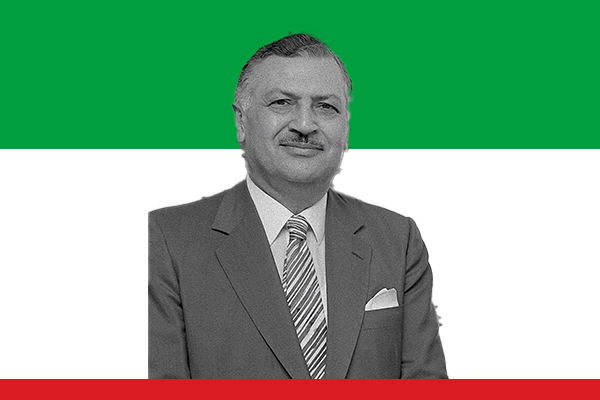
Shafik Wazzan
Shafik Wazzan was a prominent Lebanese political leader who served as Prime Minister of Lebanon during one of the most turbulent periods in the country’s modern history. Born in 1925 in Beirut, Wazzan emerged as an influential Sunni Muslim politician known for his moderate stance and efforts to preserve Lebanon’s fragile political balance. His tenure coincided with the Lebanese Civil War (1975–1990), a time marked by sectarian violence, foreign intervention, and institutional collapse. Despite the immense challenges, Wazzan sought to uphold constitutional governance and national unity.
Wazzan first assumed the office of Prime Minister in 1980 under President Elias Sarkis. At the time, Lebanon was deeply divided among various militias and political factions. The central government’s authority had weakened significantly, and large parts of the country were under the control of armed groups. Wazzan’s leadership focused on maintaining state institutions and preventing total political disintegration. His approach emphasized dialogue among Lebanon’s diverse religious and political communities, reflecting the country’s confessional political system, which allocates power among different sects.
One of the most significant events during Wazzan’s premiership was the 1982 Israeli invasion of Lebanon. The invasion further destabilized the country and led to the siege of Beirut. During this crisis, Wazzan worked alongside President Sarkis and other leaders to manage diplomatic efforts and mitigate the humanitarian consequences of the conflict. The invasion also resulted in the departure of the Palestine Liberation Organization (PLO) from Lebanon, reshaping the country’s political landscape.
After President Sarkis left office in 1982, Wazzan continued to serve under President Amin Gemayel. His ability to retain his position across different presidential administrations demonstrated his political adaptability and the trust placed in him by various factions. However, governing during wartime proved extremely difficult. The Lebanese state struggled with economic decline, infrastructure destruction, and ongoing militia rivalries. Wazzan’s government often operated with limited authority beyond parts of Beirut.
Throughout his time in office, Wazzan advocated for national reconciliation and supported initiatives aimed at restoring peace. He was known for his pragmatic leadership style and preference for negotiation over confrontation. While he did not possess strong militia backing, his reputation as a moderate figure allowed him to act as a bridge between competing groups. Nevertheless, the deep-rooted divisions within Lebanon limited the effectiveness of his efforts.
Wazzan resigned in 1984 amid escalating violence and political fragmentation. By that time, Lebanon’s civil war had entered a new phase, with shifting alliances and intensified sectarian clashes. His resignation marked the end of a significant chapter in Lebanon’s wartime political history. Despite stepping down, Wazzan remained a respected elder statesman and continued to influence Lebanese political discourse in subsequent years.
Historically, Shafik Wazzan’s premiership is viewed as a period of endurance rather than transformation. He governed during circumstances in which decisive reforms were nearly impossible. His legacy rests on his attempts to maintain constitutional order and national dialogue amid chaos. In a country frequently destabilized by internal and external pressures, Wazzan represented continuity and moderation.
He passed away in 2017, leaving behind a legacy intertwined with one of Lebanon’s most difficult eras. Though overshadowed by the broader tragedy of the civil war, his leadership remains a reminder of the challenges faced by Lebanese leaders striving to balance sectarian interests while preserving national unity.