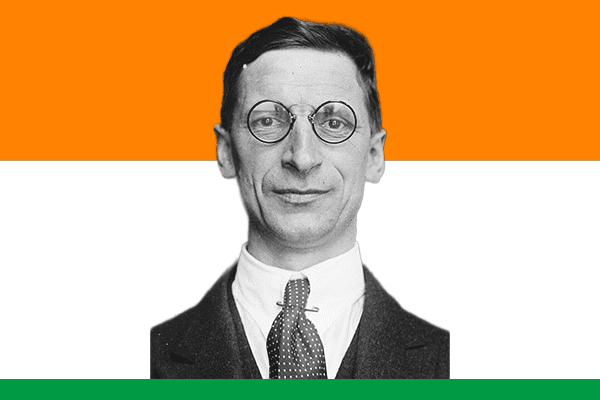
Early Life and Education
Éamon de Valera was born on October 14, 1882, in New York City. His mother, Catherine Coll, came from Ireland, and his father, Juan Vivion de Valera, was of Spanish origin. After his father’s death, his family sent him to Ireland, where relatives raised him in County Limerick.
De Valera attended local schools and later studied mathematics at Royal University of Ireland. He became a mathematics teacher and earned respect for his intelligence and dedication. During this period, he developed a strong interest in Irish culture, language, and nationalism.
Role in the Irish Independence Movement
De Valera joined nationalist organizations that sought greater freedom for Ireland. In 1916, he participated in the Easter Rising, an armed rebellion against British rule. British authorities arrested him after the uprising. Because he was born in the United States, officials did not execute him, unlike several other leaders of the rebellion.
After his release from prison, de Valera became a leading figure in the Irish independence movement. He won election to the British Parliament but refused to take his seat. Instead, he helped establish an independent Irish parliament known as Dáil Éireann. As a result, he emerged as one of the principal leaders of the fight for Irish self-government.
Political Career
In 1921, British and Irish representatives signed the Anglo-Irish Treaty. The treaty created the Irish Free State but required an oath of allegiance to the British Crown. De Valera opposed the agreement because he believed it did not provide full independence.
His opposition contributed to the Irish Civil War. After the conflict ended, de Valera formed the political party Fianna Fáil in 1926. The party quickly gained popularity and became one of Ireland’s dominant political organizations.
De Valera served several terms as Prime Minister, known in Ireland as the Taoiseach. During his years in office, he strengthened Ireland’s independence and reduced British influence on Irish affairs. In 1937, his government introduced a new constitution that renamed the state Ireland (Éire) and established many of the political structures that still exist today.
Presidency and Later Years
In 1959, de Valera became the President of Ireland. He served in this role until 1973. As president, he represented the nation at home and abroad and remained a respected symbol of Irish independence.
Throughout his life, de Valera supported the promotion of Irish culture and language. He encouraged educational and cultural programs that preserved Ireland’s heritage. Although some critics disagreed with his policies, many people admired his dedication to national sovereignty.
Legacy
Éamon de Valera left a lasting mark on Irish history. His leadership during the independence movement and his long political career helped shape modern Ireland. Historians continue to debate some of his decisions, but few question his importance in the development of the Irish nation.