ARMENIA
Armenia Flag
The national flag of Armenia consists of three horizontal stripes of red, blue, and orange. Red represents the Armenian Highlands and the struggle for survival, blue symbolizes the peaceful skies, and orange stands for the hardworking and creative people. The flag was first adopted in 1918 and re-adopted in 1990 after independence from the Soviet Union. It reflects national pride, history, unity, and the enduring spirit of the Armenian nation.
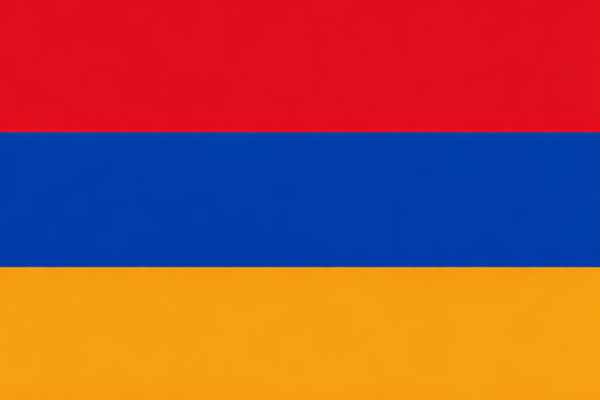
Armenia
Armenia is a landlocked country located in the South Caucasus region of Eurasia, at the crossroads of Eastern Europe and Western Asia. It shares borders with Turkey to the west, Georgia to the north, Azerbaijan to the east, and Iran to the south. The capital and largest city is Yerevan, one of the world’s oldest continuously inhabited cities.
Armenia has a rich and ancient history. It is widely recognized as the first nation to adopt Christianity as a state religion in 301 AD. The Armenian Apostolic Church remains a central part of national identity. Throughout history, Armenia was ruled by various empires, including the Persian, Roman, Byzantine, Arab, Ottoman, and Russian empires. In 1918, Armenia briefly gained independence, but it later became part of the Soviet Union in 1922. After the dissolution of the Soviet Union in 1991, Armenia regained its independence.
The country’s geography is mostly mountainous, with the Lesser Caucasus Mountains covering much of its territory. One of its most important natural landmarks is Mount Ararat, a national symbol of Armenia, although it is now located within modern-day Turkey. Lake Sevan is another significant feature and is one of the largest high-altitude freshwater lakes in the world.
Armenia’s economy is based on mining, agriculture, energy, and increasingly on information technology and services. The country has developed a growing tech sector in recent years. Despite facing economic challenges and regional conflicts, Armenia continues to focus on modernization and development.
A major issue in Armenia’s recent history has been the conflict over Nagorno-Karabakh, a disputed region between Armenia and Azerbaijan. Tensions have led to armed clashes and wars, most recently in 2020. The situation remains sensitive and affects regional stability.
Culturally, Armenia is known for its unique alphabet, created in the 5th century by Mesrop Mashtots. Armenian literature, music, and traditional dance reflect deep historical roots. Armenian cuisine, including dishes like lavash (traditional flatbread), is an important part of its heritage.
Today, Armenia is a democratic republic with a president as head of state and a prime minister as head of government. The country is a member of several international organizations and seeks to maintain balanced foreign relations.
Hearing in Armenia
The term “hearing” in Armenia can refer to legal, parliamentary, or court hearings. The Armenian judicial system includes courts of first instance, appellate courts, and the Court of Cassation. Public hearings are an important part of the legal process, ensuring transparency and fairness. Parliamentary hearings are also held to discuss national issues, proposed laws, and government policies. These hearings allow citizens, experts, and officials to present opinions and provide input into decision-making processes.