PHILIPPINES
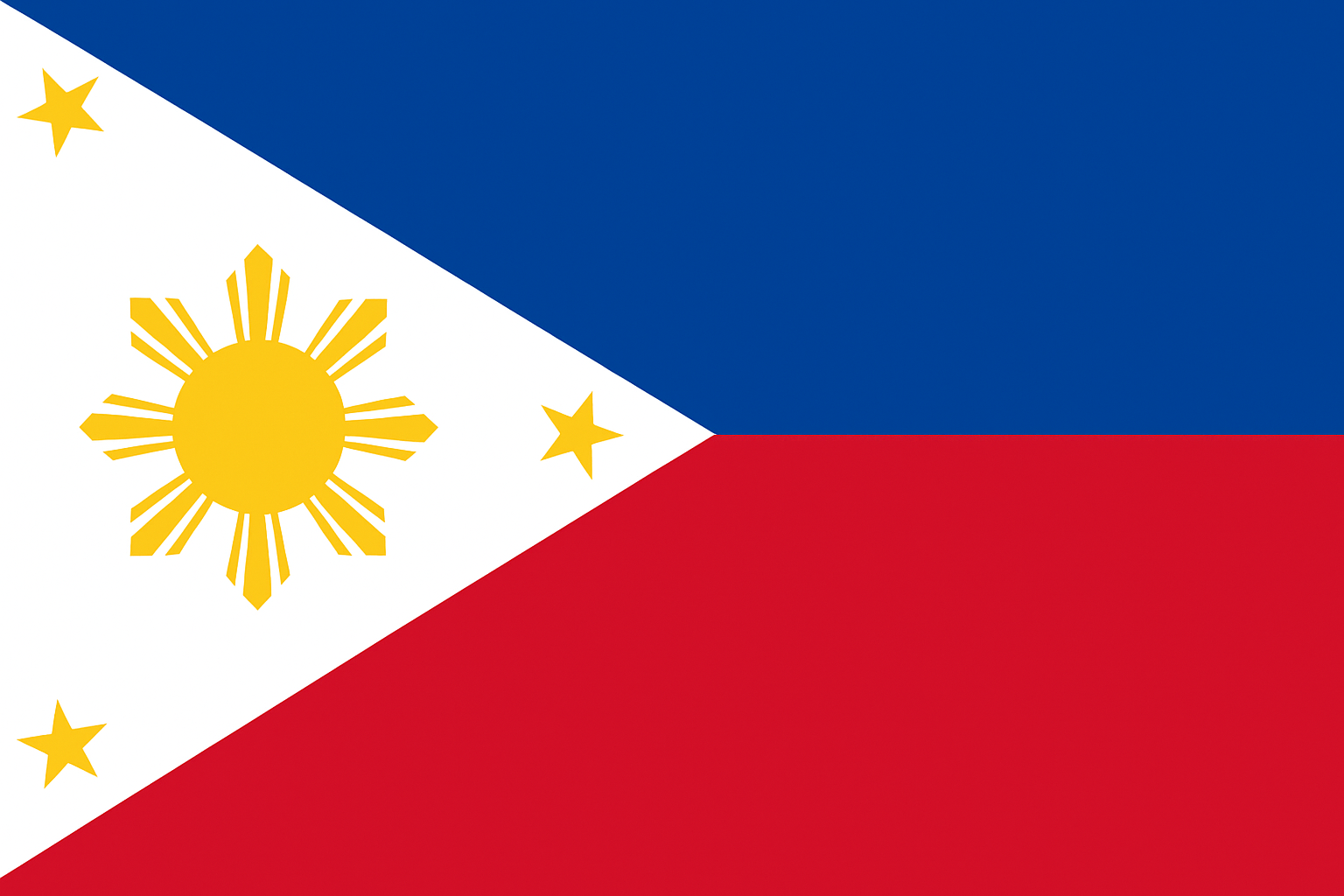
Philippines Flag
The flag of the Philippines symbolizes the nation’s independence, unity, and courage. It features two horizontal bands—blue for peace and justice, and red for bravery and patriotism. On the left is a white equilateral triangle representing equality and liberty. Inside the triangle is a golden sun with eight rays, symbolizing the first provinces that fought for freedom, and three golden stars representing Luzon, Visayas, and Mindanao, the country’s three main island groups.
Overview
The Philippines: A Nation of Islands, Culture, and Resilience
The Philippines, officially known as the Republic of the Philippines, is an archipelagic country located in Southeast Asia. It consists of more than 7,000 islands, divided into three main geographical regions: Luzon, Visayas, and Mindanao. With its capital in Manila and Quezon City as its largest urban center, the Philippines is a country rich in history, natural beauty, and cultural diversity.
Geography and Natural Beauty
The Philippines lies in the western Pacific Ocean and is surrounded by the Philippine Sea, the South China Sea, and the Celebes Sea. The country boasts a tropical climate, with lush forests, white-sand beaches, and stunning coral reefs. Natural wonders such as the Banaue Rice Terraces, Taal Volcano, and the Chocolate Hills highlight its breathtaking landscapes. The Philippines is also home to a rich variety of flora and fauna, making it one of the world’s biodiversity hotspots.
History and Independence
The Philippines has a long and complex history shaped by foreign influences and a strong spirit of independence. Before Spanish colonization in 1565, the islands were inhabited by diverse ethnic groups engaged in trade with neighboring Asian nations. Spain ruled the country for over 300 years, introducing Christianity and Western culture. In 1898, after the Philippine Revolution, the nation declared independence but was later occupied by the United States following the Spanish-American War. The Philippines finally gained full independence on July 4, 1946, becoming a sovereign republic.
Culture and Language
Filipino culture reflects a blend of indigenous traditions and foreign influences from Spain, America, and Asia. Family is the cornerstone of Filipino life, and hospitality is a defining national trait. Festivals, known as fiestas, are celebrated across the islands with colorful parades, music, and dance. The official languages are Filipino and English, with more than 170 regional dialects spoken nationwide. The Philippines is also known for its contributions to music, arts, and literature, as well as for its global community of skilled workers.
Economy and Modern Development
The Philippine economy is one of the fastest-growing in Asia, driven by services, manufacturing, and remittances from overseas Filipino workers (OFWs). Tourism, business process outsourcing (BPO), and agriculture are also key sectors. Despite challenges such as poverty and natural disasters, the Filipino people remain resilient and optimistic.
Conclusion
The Philippines stands as a symbol of diversity, endurance, and cultural richness. Its people, known for their warmth and determination, continue to shape a nation that harmonizes tradition and modernity. With its vibrant culture, natural beauty, and growing economy, the Philippines proudly embodies the spirit of unity and progress in Southeast Asia.