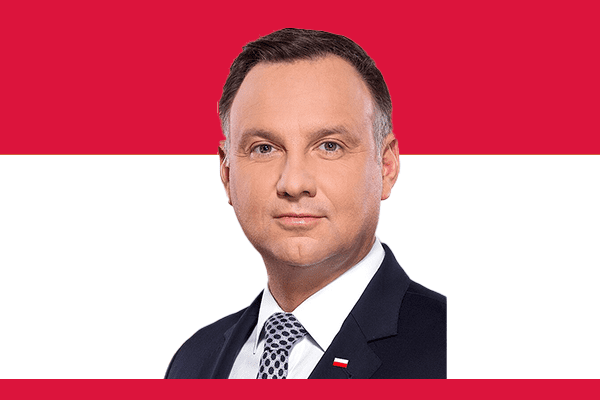
Early Life and Education
Andrzej Sebastian Duda was born on May 16, 1972, in Kraków, Poland. He grew up in a family that valued education and intellectual development. His father, Jan Tadeusz Duda, worked as a professor of electrical engineering, and his mother, Janina Milewska-Duda, was also connected to academic life. This environment helped shape his disciplined and ambitious personality.
Duda studied law at the Jagiellonian University in Kraków, one of the oldest and most respected universities in Europe. He completed his legal studies successfully and later earned a doctoral degree in law. Before entering high-level politics, he worked as a legal scholar and lecturer. His academic background gave him a strong understanding of constitutional matters and public administration, which later became useful in his political career.
Political Career
Andrzej Duda began his political journey by becoming involved in public service and legal advisory roles. He worked with the Ministry of Justice and later became associated with the Law and Justice Party (PiS), a major conservative political force in Poland. His political career advanced steadily because of his legal expertise and communication skills.
In 2008, he served as the Undersecretary of State in the Chancellery of President Lech Kaczyński. This role increased his national visibility and allowed him to gain valuable experience in presidential affairs. After that, he became a member of the Polish parliament and later served in the European Parliament from 2014 to 2015.
In 2015, Andrzej Duda won the presidential election and defeated the incumbent president, Bronisław Komorowski. His victory surprised many observers and marked a major shift in Polish politics. He campaigned on promises of social support, national pride, judicial reform, and stronger state institutions.
Presidency and Major Achievements
As President of Poland, Andrzej Duda has emphasized national identity, family values, and security. He has supported social welfare programs that helped many families, especially through child benefit schemes. He has also worked closely with the government on reforms related to the judiciary and state institutions.
One of his major priorities has been national defense. He has strongly supported closer military cooperation with the United States and NATO. Under his leadership, Poland increased its focus on military modernization and regional security, especially because of tensions in Eastern Europe.
Duda has also taken an active role in foreign policy. He has represented Poland in European Union discussions while defending the country’s sovereignty. He has often argued that Poland should protect its own traditions and political independence within the European framework.
Criticism and Legacy
Despite his achievements, Andrzej Duda has faced criticism from opposition groups, European institutions, and civil society organizations. Critics have argued that he has too often supported the policies of the ruling Law and Justice Party instead of acting as an independent president. His support for judicial reforms has especially caused controversy because some observers believe those reforms weakened judicial independence.
However, his supporters see him as a defender of Polish values, security, and national interests. They praise his commitment to family-oriented policies and his efforts to strengthen Poland’s international position.
Conclusion
President Andrzej Duda remains a significant figure in Polish politics. His presidency has shaped debates on democracy, sovereignty, law, and identity in Poland. Through his legal knowledge, political experience, and firm leadership style, he has left a lasting impact on the nation. Whether admired or criticized, Andrzej Duda continues to be remembered as a powerful and influential President of Poland.