Megawati Sukarnoputri
In Office: 23 July 2001 – 20 October 2004
Political Party: Indonesian Struggle
Home State: Yogyakarta
Lifespan: born 1947
Country: Indonesia
Image credits available here.
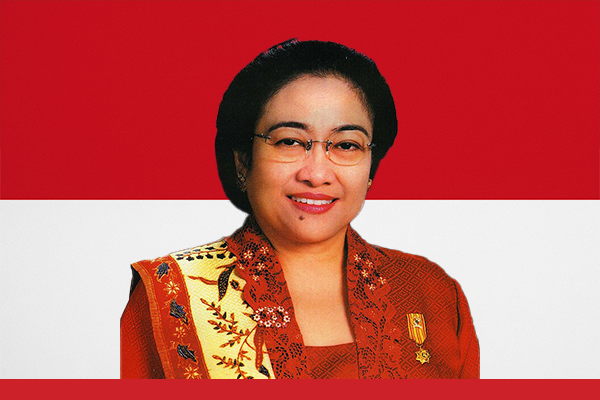
Early Life and Political Roots
Megawati Sukarnoputri was born on January 23, 1947, in Yogyakarta, Indonesia, as the daughter of Indonesia’s first President, Sukarno. She grew up in an environment filled with political discussions and nationalistic ideals. Her father’s influence inspired her to engage deeply in Indonesia’s social and political development. Although she initially focused on family life, Megawati later stepped into politics to continue her father’s legacy and defend democratic values.
Rise in Indonesian Politics
Megawati began her political journey by joining the Indonesian Democratic Party (PDI). Her leadership potential soon became evident, and she steadily gained popularity for her integrity and simplicity. In 1993, she was chosen as the leader of the PDI, but her rise faced opposition from the ruling government of President Suharto. Despite attempts to remove her from power, she continued to command widespread public support. Her courage and persistence turned her into a symbol of reform and resistance during the last years of Suharto’s rule.
After Suharto’s resignation in 1998, Indonesia entered a period of political transition. Megawati played a vital role in stabilizing the nation’s democratic process. She reorganized her party under the new name, the Indonesian Democratic Party of Struggle (PDI-P), and positioned it as one of the country’s most influential political movements. Her consistent efforts to promote transparency, justice, and equality earned her both respect and a strong political base.
Presidency and Leadership
Megawati Sukarnoputri became Indonesia’s fifth president in July 2001 after President Abdurrahman Wahid’s impeachment. As the nation’s first female president, she faced the immense challenge of leading a country recovering from political instability and economic crisis. She took decisive actions to restore confidence in the government and strengthen democratic institutions.
Her administration focused on economic recovery, anti-corruption measures, and national unity. She encouraged investment, stabilized inflation, and ensured that Indonesia’s economy gradually regained strength after the 1997 Asian financial crisis. She also emphasized good governance and pushed for reforms in the civil service to create a more transparent administration.
Megawati prioritized national security and territorial integrity. She acted firmly to address separatist movements in Aceh and Papua, deploying diplomatic and military strategies to preserve national unity. Her leadership reflected a balance between firmness and moderation, and she worked to rebuild the people’s trust in their government.
Foreign Policy and International Relations
In foreign policy, Megawati strengthened Indonesia’s diplomatic relationships with neighboring countries and global partners. She represented Indonesia as a confident and independent nation while promoting peace and cooperation in Southeast Asia. She supported ASEAN’s vision for regional stability and actively engaged in dialogues to advance Indonesia’s role in international affairs. Her balanced approach helped restore Indonesia’s global image after years of turmoil.
Legacy and Impact
Although Megawati’s presidency ended in 2004 after she lost the election to Susilo Bambang Yudhoyono, her influence on Indonesian politics remained significant. She continued to lead the PDI-P and mentored a new generation of leaders, including President Joko Widodo. Her tenure demonstrated that women could hold the highest office in Indonesia and lead with authority and dignity.
Megawati’s legacy lies in her resilience and dedication to democracy. She upheld her father’s vision of a united Indonesia while carving her own path as a pragmatic and decisive leader. Through her leadership, she strengthened Indonesia’s political institutions and paved the way for future progress.