KYRGYZSTAN
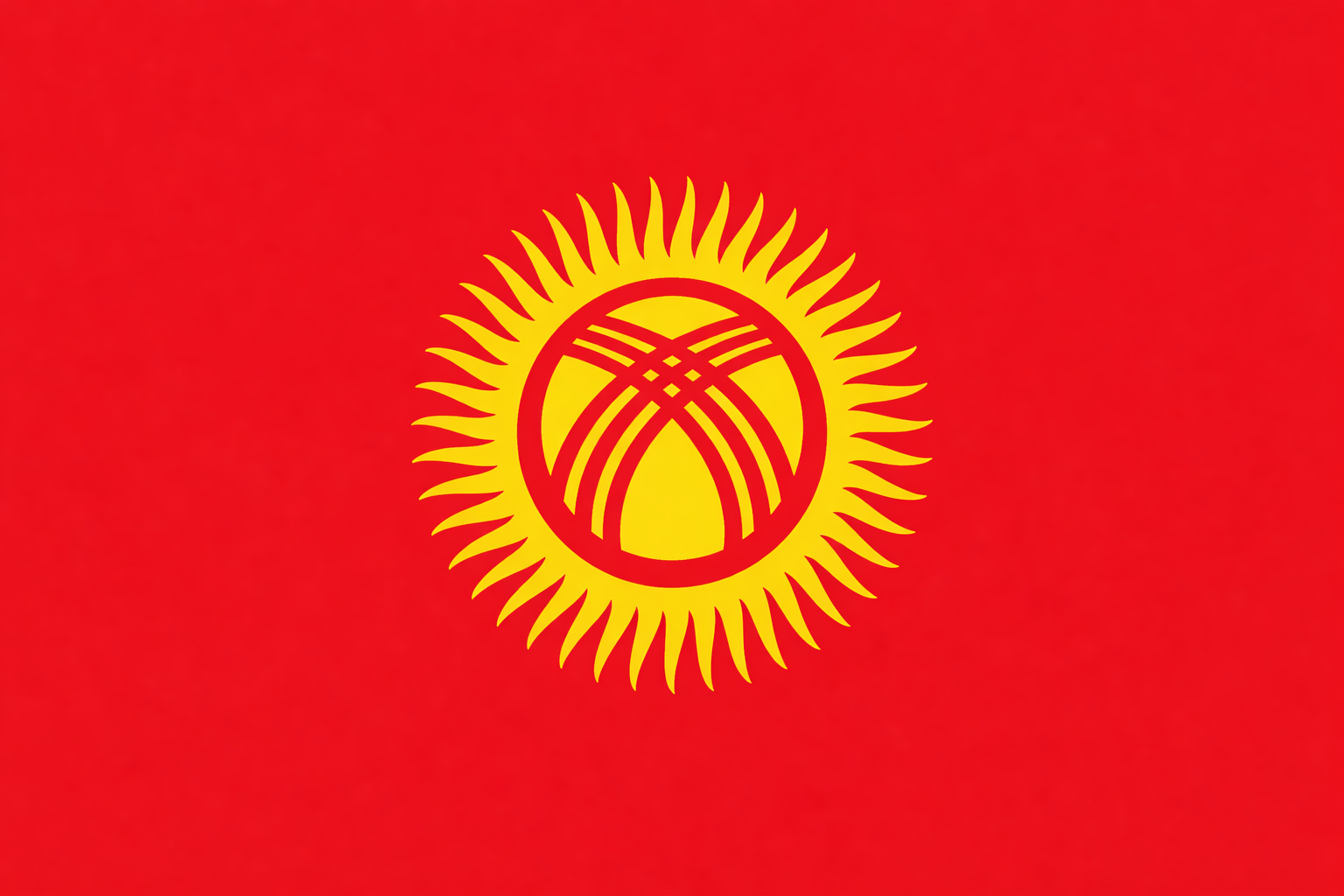
Kyrgyzstan Flag
The flag of Kyrgyzstan features a bright red background symbolizing courage and valor. At the center is a yellow sun with forty rays, representing unity among the forty ancient Kyrgyz tribes. Inside the sun lies a stylized tunduk, the circular roof opening of a traditional yurt, symbolizing home, family, and the universe. Adopted in 1992, the flag reflects national heritage, independence, cultural identity, and the strong spirit of the Kyrgyz people.
Introduction
Kyrgyzstan, officially known as the Kyrgyz Republic, is a landlocked country located in Central Asia. It is bordered by Kazakhstan to the north, Uzbekistan to the west, Tajikistan to the south, and China to the east. Known for its dramatic mountain landscapes, nomadic traditions, and rich cultural heritage, Kyrgyzstan plays an important role in the history and geography of Central Asia. The capital city of the country is Bishkek.
Geography and Climate
Kyrgyzstan is one of the most mountainous countries in the world, with nearly 90 percent of its land covered by the Tian Shan and Pamir-Alay mountain ranges. Many peaks rise above 7,000 meters, making the country a popular destination for trekking and mountaineering. The climate is continental, with cold winters and warm summers. Valleys experience milder weather, while high-altitude regions remain cold throughout the year.
History
Kyrgyzstan has a long and complex history influenced by ancient nomadic cultures and major trade routes such as the Silk Road. Over centuries, the region was ruled by various empires, including Turkic khanates, the Mongols, and later the Russian Empire. In 1936, Kyrgyzstan became a Soviet republic. After the collapse of the Soviet Union, it gained independence in 1991 and began its journey as a sovereign nation.
Government and Politics
Kyrgyzstan is a republic with a parliamentary system of government. It has experienced several political changes since independence, including popular uprisings that reshaped its leadership. The President serves as the head of state, while the Prime Minister leads the government. Compared to other Central Asian nations, Kyrgyzstan has a relatively active political environment.
Economy
The economy of Kyrgyzstan is largely based on agriculture, mining, and services. Gold mining, particularly from the Kumtor Gold Mine, is a major contributor to the national economy. Agriculture employs a large part of the population, with crops such as wheat, cotton, potatoes, and tobacco. Many Kyrgyz citizens also work abroad, and remittances form an important source of national income.
Population and Culture
Kyrgyzstan has a population of over six million people. The majority are ethnic Kyrgyz, along with Uzbeks, Russians, and other minority groups. The official languages are Kyrgyz and Russian. Traditional culture is strongly influenced by nomadic life, reflected in yurts, horse games, folk music, and epic poetry such as the “Manas” epic.
Conclusion
Kyrgyzstan is a country of natural beauty, cultural richness, and historical significance. Despite economic and political challenges, it continues to preserve its traditions while working toward development and stability in Central Asia.